Lee este blog en español:
Lo leemos así

Read my other blog:

Interested in Philosophy for Children?
Showing posts with label toddlers. Show all posts

Friday, 10 July 2015

John Burningham's Little Book Series: 'and he peed on the flowers'

The Little Books Series
John Burningham
The School (1974), The Snow (1974), The Baby (1974), The Rabbit (1974), The Dog (1975), The Cupboard (1975), The Blanket (1975), The Friend (1975).
Originally published in Johnathan Cape. All currently out of print.


Originally published in 1974 and 1975 but, though reprinted several times since, currently out of print -for a good few years now-, this fantastic series of great Little Books -just that- by John Burningham is both a childhood memory and an adult 'wow-how-simple-yet-how-incredibly-difficult-to-do-just-right' realisation. 

Each of these little books has 9 double spreads, with text on the left and an illustration on the right, plus an inside cover and an inside back cover. That's it. The number of words in each one ranges from 27 (The School) to 65 (The Blanket). In these few words and few pages, Burningham remarkably manages to fit in the story of an experience from the child's point of view: an experience -often a first experience- with a beginning, a middle and an end, and with room for the character to develop somewhere between the first page and the last. 

Burningham himself writes about these 'first experience' books in his autobiography John Burningham (Johnathan Cape, 2009): 
'If you have small children, you observe them. You know other people with small children and take note of that world. When my daughter Lucy was about two she used to wake incredibly early in the morning as most small children do. There was a programme on the radio called, 'Make Yourself at Home', which was broadcast for immigrants from the Indian continent to learn English. The programme used to start with a bit of Indian music. On this day, Lucy suddenly did the dance movements with her arms. It was extraordinary to see because it was instinctive.' 

These books speak from a child's viewpoint and talk straight to the child reader in a way very few children's books do. They are the result of much watching the way children watch, experience and understand the world they live in. 

The world of The Little Books series is one where adults give contradictory messages, exciting experiences often come with danger or mishaps, babies are suddenly brought into the house and are there to stay, or the neighbour's dog visits for the day -and pees on the flowers.

The first in the series is The School , the shortest and perhaps simplest of them all.


'When I go to school / I learn to read / And to write / Sing songs / Eat my dinner / Paint pictures / Play games / Make friends / And then go home'

Most of the pictures are frontal almost as if profiles hadn't been invented yet, mimicking actual drawings of children at this age. In many of them, the boy stares out from the page, and tells us all about it.

One of the things I like best about these Little Books is how they manage to convey a young child's sense of time, whereby a day can be satisfactorily and completely condensed in 27 words.

The next is The Snow.


'One day it snowed / Mummy and I rolled a big snowball / We made a snowman / I sat on the sledge / Mummy pulled me / But I fell off / I lost my glove and I was cold / So we went indoors / I hope the snow is here tomorrow'

The mimicking is not only in the superb drawings but also in the text, which mirrors exactly the way a kid might tell you about the day it snowed. The story manages to combine the excitement of a first day of snow, the pride and satisfaction of having made something, the joy of playing with Mummy, the accident and the feeling of pain and disappointment that comes with it, AND the lost glove AND the cold. But soon it's all fixed by going indoors. The day has been intense, with fun and with tears. And wouldn't it just be wonderful if we did it all again tomorrow?  

The sense of time I mentioned in The School now includes the future. Please let's have another today tomorrow. AKA the famous 'Again! Again!'. 

In The Baby, the baby doesn't have a name or a gender: 


There is a baby in our house / The baby makes a mess with its food / We take it for rides in the pram / Sometimes I help Mummy bath the baby / The baby sleeps in a cot / Sometimes I like the baby / Sometimes I don't / It can't play with me yet / I hope the baby grows up soon 

The ambivalence towards a new arrival in the house is conveyed through the observant eyes of the older child: 'What on earth is this thing?'. And then eventually, somwhere, an intuitive understanding that one day this thing will be rather like him.

The Rabbit tells the experience of getting a first pet:  


We have a rabbit / The rabbit has a hutch in the garden / His favourite food is dandelions / I like to stroke the rabbit / Sometimes the rabbit gets out / He likes to hop about in the garden / I would like him to stay in the garden but he eats Daddy's plants / so I have to catch him / and put him back 

I used to love this one when I was a kid. I'm pretty sure I learnt the word 'dandelion' from this book. I wanted to stroke the rabbit, I also wanted the rabbit to stay, and I also wanted to have fun catching him and returning him to his hutch. 

With this Little Series of Book, if the child reading them or having them read to happens to have lived the experience in particular, they feel identified. If they haven't, they might feel like they'd like to. I didn't have a pet as a young child and I remember feeling what it was like to have a pet when looking at this book. The combination of observation of the rabbit as a foreign creature and the relationship of the child and the rabbit brings the experience to life for the reader. And it seems so simple! 


In The Dog, the boy experiences having a dog for a day.  


One day a dog we know was left at our house / Mummy said I could look after him / He ate the cat's dinner / He licked me / He ran into the garden with Daddy's shoe / And he peed on the flowers / Then he dug a hole in the garden / So I put him on his lead / I wish the dog could stay with me / 

One of the pages in this book 'provoked a furore from parents, teachers, booksellers, librarians and the press', according to Burningham's account in John Burningham (Johnathan Cape, 2009). 

'And he peed on the flowers'. 
 Ouch. Burningham gives further detail: 
One parent wrote:
'Recently my four year old son was given one of your books for his birthday. It was called the Dog by John Burningham. On looking at the book we were absolutelly disgusted at the contents of page 12 and 13. What a thing to put in a child's book. I shouldn't have thought you would have printed such crudeness. What worries my husband and I is if this is what you put in the story of the dog whatever do you put in the story of the rabbits?'
The Dog was withdrawn from some libraries and schools were put under pressure from parents. A bookshop owner in Devon demanded to be credited by my publisher for a book returned by an indignant customer. A library found the offending pages had been ripped out. And Mary Whitehouse was quoted in the Worthing Gazette saying: 'I think this section of the book which is aimed at four to five year olds is supremely unnecessary'. 
But I was damned if I was going to change the word to some childish euphemism. I had used correct English.
pee, v.i. to urinate- also n. [For piss]'
We love it: a child delightedly watching a dog in an unknown house break all the rules. He eats the cat's dinner, pees on the flowers, grabs Daddy's shoe, before the realisation that it might be a good idea to put him on his lead. And again: more tomorrow? Yes, please!

The Cupboard is one of my favourite ones, and my son's too.


There is a cupboard in our kitchen / It is full of pots and pans / I like to take them all out / And play with them / Mummy says why don't I think of something else to do / Because I am in the way / So I think of something else to do / But Mummy says will I please come back / And put all the things away

I love the way the boy recounts the mother's contradictory orders in a completely matter-of-fact way and the appropiation of the entire contents of a house as toys.

The Blanket is the dramatic story of the loss of a blankie just before bedtime.


When I go to bed, I always take my blanket / One night I could not find my blanket / Mummy looked in the bathroom / Daddy looked in the cupboard / And I looked under my bed / But we could not find the blanket / So Mummy looked in the washing / And Daddy looked in the car / But I found the blanket under my pillow and went to sleep. 

I never was a blankie girl myself, but my son is certainly a Teddy boy and oh the dramas we have experienced. Once we even left Teddy behind when we went on holiday! And he wasn't under the pillow.

In this story we love the almost army-like search expedition, not once, twice round, until he finally finds it himself-exactly where it should be.


And the last story in the series, The Friend tells the story of a boy and his best friend, Arthur. 


Arthur is my friend / We always play together / We play outside when it is nice / and stay inside when it is raining / Sometimes I don't like Arthur / so Arthur goes home / Then I'm by myself / I have other friends, of course / But Arthur is my best friend. 

This onw reminds me of another favourite of ours on the subject of friendship: Janice May Udry and Maurice Sendak's Let's be Enemies. But the way Burningham manages to fit in a similar line of development in this number of pages and words is just stunning.

Illustrations
Not at all like the illlustrations in Borka, Trubloff, or Canonball Simp and other similar early work, though somewhat closer to the style of Mr. Gumpy, the simple line drawings on white backgrounds in these Little Books are absolutely fantastic in their simplicity and in their mirroring of actual children's drawings -especially in the faces-. Two dots a hook line for a nose and a line for the mouth is all Burningham needs to bring the character to life. The somewhat rigid, forward facing drawings of the boy are brought to life by the tremendous amount of action on the pages. Something is happening on every page and in this sense they are great to look at again and again.

Read-aloud and read-alone
Written in first person, these books are perfect for older kids who are learning to read to give them a go when they are ready. The use of the first person is great for children of this age to make these books their own.

But these are also books to be read out loud to much younger children. Although the texts are very short, they seem to spark the 'Again! Again! Again! reaction every time with very little ones.

What I like about these Little Books
I like that John Burningham never tries to fit a lesson in while he's at it. I like that they are written from the child's point of view and speak directly to the child. One can hardly feel the adult presence, except as another element for the child to react to and bear in mind. I like that they boy is not naughty or good, just a kid trying to navigate life and the world and making a more or less decent job of it. I like that the parents only appear as background characters,  if they appear at all, letting the child lead his life, make mistakes and handle the mistakes he makes. I love how the author-illustrator's perceptive observation seeps through every page without us hearing him and without him getting in the way. Having done a fair share of observing, Burningham creates this character and then feeds him seven experiences, steps back and lets the character react and speak and tell us all about it.

These books are a set of little masterpieces that should be released again and then be kept in print for a long, long time.

(c) of all the illustrations in this post, John Burningham.  
(c) of the text, Ellen Duthie. You may copy this or reproduce it, but please be nice and credit the author and the site.

Sunday, 4 September 2011

We're Going on A Bear Hunt: Hoooo woooo! Hoooo woooo!

We're Going on a Bear Hunt, by Michael Rosen (writer)
& Helen Oxenbury (illustrator), Walker Books, 1989.
Our edition: Walker Books, 1997.

Click on the cover to listen to the way we read We're Going on a Bear Hunt by Michael Rosen and Helen Oxenbury.


We're Going on a Bear Hunt is a family adventure of playful bravery, evocative noises and giggly fear.

The Story
Based on an old campfire song, We're Going on a Bear Hunt tells the story of a family (refreshingly, a father with four kids and a dog) that sets out one morning on an adventure to catch a bear. They are determined ("We're going on a bear hunt"), confident (We're going to catch a big one), optimistic ("What a beautiful day!") and fearless ("We're not scared").

On the way, they encounter all sorts of obstacles they "can't go over and can't go under" but just have to "go through", and, luckily, they all make interesting noises. These obstacles include a field of long wavy grass (swishy swashy), a deep cold river (splash splosh), a field of thick oozy mud (squelch squerch), a big dark forest (stumble trip!), a swirling whirling snowstorm (Hoooo woooo!) and finally a narrow gloomy cave (tiptoe! tiptoe!).

Waiting for them in the cave is the last thing they expect to find. An actual bear! They all turn around and run out, having to make their way back through all the obstacles in reverse order, making all those funny noises again, but far more quickly and with the bear running after them, back to their front door and eventually into bed and under the covers with the determination never to go on a bear hunt again.

The Illustrations
Helen Oxenbury's pencil and watercolour illustrations, alternating colour and black and white double page spreads, bring to life this family's day out, with a perfect rendering of that combination of excitement and contented exhaustion children tend to display on a day out.

We're Going on a Bear Hunt has wonderful movement scenes:

Splash splosh


Oh no! We forgot to close the door!

And just as great scenes of the family at rest in between obstacles:


We like the faces of them all when they enter into the cave:
Tiptoe! Tiptoe!


And when they get to the bedroom. Aaaah!


Our son loves the scene where they are under the blanket, particuarly the head poking out in the bottom left hand corner and the safe teddy-bear the baby is playing with:


And we all like the last scene, of course, with the bear walking back alone, looking more like he's in need of a friend than a bite to eat:


Reading it Aloud
We're Going on a Bear Hunt is written to be recited or sung out loud.

We did not know the song it is based on and I confess we found it hard to find a comfortable rhythm to it at the very start. It somehow seemed to fall flat. However after a few readings, we made it our own and our son has loved it ever since (we bought it when he was around 15 months).

It has all the perfect elements to be read aloud to young kids: repetition (both words and rhythm), plenty of interesting sounds, and a sudden change in tempo which breaks the tension and brings on a wonderful comic effect that gets children giggling every time, before it all calms down again right at the end. And on top of all that, the chance -almost the compulsion- for the child to join in, with voice or body or both.

We sometimes read it "quietly" and concentrate on the sounds (like in the recording), or read it more actively, acting it out, moving our hands through the grass while we say swishy swashy, pretending to swim through the splash splosh, getting up and walking in the squelch squerchy mud and pretending to stumble and trip through the forest, before shivering through the snowstorm and tiptoeing into the cave and then doing it all in reverse order on the way back!

Whether we are reading it quietly or actively, we always move our arms to:

We can't go over it.
We can't go under it. 
Oh no!
We've got to go through it!


A couple of interesting We're Going on a Bear Hunt videos:

Check out this lightly animated version of the story:


And Michael Rosen himself telling it: 

(c) of all the illustrations in this post: Helen Oxenbury, 1989.

Friday, 24 June 2011

Rosie's Walk: Picture book perfection

Rosie's Walk, by Pat Hutchins. The Bodley Head, 1968.
Our edition, Red Fox, Random House Children's Books, 2009.


Rosie's Walk is, simply put, picture book perfection.

A single, plain, thirty-two word sentence sewn together with seven prepositions, tells us of a routine walk of a hen from her coop, across the yard, around the pond, over the haycock, past the mill, through the fence, under the beehives and back to her coop.  But combined with the illustrations? We get a whole other, rather more eventful story of the misfortunes of a very hungry fox who is chasing the oblivious hen on her routine walk and managing to get himself into one silly pickle after another.

We bought it for our son recently and he burst out laughing with every scene where the fox 'gets it' from the very first time we read it. A wonderfully silly giggly book, with loud laughter guaranteed.

The illustrations
Pat Hutchins' pen and ink drawings in Rosie's Walk are delightful compositions made up of intricate geometric patterns in different shades of orange, green and yellow.

Look at the fox's fur in this close-up (!):


The story opens with a double page spread showing the whole farm scene or obstacle course, depending on whose point of view you take:


And we are then taken on a visual tour around the farm with Rosie leading, the desperate fox following and us watching it all.

Here, the fox has almost caught up with Rosie:


But look what's in store for him!:


Voilà one of our son's favourite scenes:


And here's Rosie coming to the end of her walk, with the fox in the distance, running from the bees:


Between, behind and beside the two-dimensional slapstick scenes, there are plenty of little details in the form of flowers, insects and other wildlife, including a wonderful onlooking goat, a rabbit, a snail, two toads who seem keen to be part of the action, a couple of mice, a beaver, a couple of grasshoppers and plenty of bees!


Reading it out loud
This book is more about sharing out loud than strictly reading out loud, as the text is kept to an absolute minimum. It's perfect for pointing things out, laughing and shouting out to the unaware hen. 'Watch out!' Plus, all the little details in every drawing make for plenty of conversation.

We haven't provided a recording for this one because every time we read it, we do it so differently!

What we like about it
I love that the story is absolutely no fun without the illustrations, but hilarious with them.

I like how it very cleverly and simply introduces the sophisticated idea of different perspectives (the hen, the fox, the reader).

(c) of all the illustrations in this post, Pat Hutchins, 1968. 

Saturday, 11 June 2011

The Tiger who Came to Tea: Owp!

The Tiger Who Came to Tea, by Judith Kerr, 1968. 
Our edition: HarperCollins, 2007. 
Click on the cover to listen to the way we read The Tiger Who Came to Tea. 

First published in 1968, Judith Kerr's The Tiger Who Came to Tea continues to be one of the best selling and best loved children's books in the UK. It was an instant hit with my son too when we bought it for him at around the age of eighteen months, and seems to be set to continue to be one of his favourites for some time to come.

The secret behind having remained a hit over forty years after its publication date, despite more than a couple of dated elements -some of which, such as the reference to 'Daddy's beer', rather amusing to refer to out loud- has to be the charming and surreal matter-of-factness and nonchalance of how the girl and the mother in the story let a tiger in to have tea with them in their kitchen.

The sudden appearance of this 'big, furry, stripey tiger' in an entirely routine mother-and-daughter scene is portrayed as exciting and fun, but at the same time, as something absolutely natural and fine. A tiger for tea? No problem, we can handle that. The mother and daughter are both part and onlookers of each of the scenes and this makes readers feel like they are also both watching and taking part. It draws you into a story and into the rather fun possibility that the doorbell could ring any time now and it just could be a tiger. How about that as a thought to entertain on a rainy afternoon?

The story
Sophie and her mother are having their afternoon tea in the kitchen when the doorbell rings. They wonder who it might be, but cannot think of who, so go to the door and see. 

When Sophie opens the door she finds a tiger who politely invites himself in: "Excuse me, but I'm very hungry. Do you think I could have tea with you?". Sophie's mother lets him in and offers him a sandwich. The tiger eats all the sandwiches on the plate in one big mouthful. 'Owp!', and, still looking hungry, proceeds to do the same with all the buns, all the biscuits, all the cake, washing it down with all the milk in the jug and all the tea in the teapot. He then looks round for more, until he eats every last bit of food and every last bit of liquid in the house, including all the water in the drains. 

He then, also very politely, says "Thank you for my nice tea. I think I'd better go now", and leaves.   

When Sophie's Daddy gets back, they tell him all about the tiger and what happened and he suggests they go out for a meal. So they go out in the dark, with 'all the street lamps lit' and eat in a cafe.

The next day Sophie and her mummy go shopping and remember to buy a tin of tiger food just in case.

The illustrations
  
Judith Kerr's ink and crayon illustrations use a warm palette of colours to achieve a marvellously expressive portrayal of a very remarkable experience in comfortingly familiar terms. 

Here are a few of the illustrations from The Tiger Who Came to Tea: 

The tiger sits down to tea

Drinking all the tea in the teapot
Drinking all the water in the tap

I must say I absolutely love the tiger's nice, cheeky face. 

And I love Daddy's matching tie and socks, here:


Reading it out loud

The Tiger Who Came to Tea is great to read out loud for several reasons. It has repetition (mainly with "all": all the tea in the teapot, all the packets in the cupboard, all the street lamps were on..."), dialogue (a chance to do different voices), and a wonderfully restrained and effective use of occasional rhyme (tea, be, key, see).   

There were several things our son loved about The Tiger Who Came to Tea from the very beginning, when he was about 18 months. He particularly loved: 1) the tiger eating everything up in one big mouthful: 'OWP!'-this has been used more than once as a mealtime encouragement and works wonders-, 2) the picture of Daddy holding his key: 'KEY!', 3) the image of Daddy arriving home and taking his hat off: 'Hello!' -we add in the 'Hello'-, 4) pointing out the sausages they are eating in the café and 5) the tiger playing the trumpet at the end: Good-bye--- Good-bye... Good-bye -we ended up buying him a wee toy trumpet as a result-.

From the point of view of the person reading it out loud, it's got a nice rhythm and flow to it and comfortably withstands more than a couple of consecutive readings. 

Bits and bobs

Lots of people seem to get upset about the mother being a bit of a 'drip', the tiger drinking 'all of Daddy's beer' and them having 'nothing for Daddy's supper'. It is true that even for the 60s, it's all a bit 50s. If it really upsets you, I suppose you can always change those bits or leave them out (but then would you change the meal at the end for something healthier than sasauges, chips and ice-cream too?). In the version that was published in Spain last year, they 'edited out' both those references to Daddy. On the other hand, you could also lighten up and enjoy the thrill of letting a stranger into your house. 

One of the things I love about the end of The Tiger Who Came to Tea is the sense of something special going on when they venture out of the house for dinner and it's dark outside. 'All the street lights were lit and all the cars had their lights on'. Almost as exciting as a tiger coming to tea.

If you are interested in reading more about Judith Kerr (also the author of the Mog series and of When Hitler Stole the Pink Rabbit), try these links here: 


(c) of all the illustrations in this post, Judith Kerr, 1968. 


Thursday, 14 April 2011

Monkey and Me: Time for Charades!

Monkey and Me, by Emily Gravett, 2007.
Our edition: Macmillan Children's Books, 2010.
Click on the cover to listen to the way we read Monkey and Me by Emily Gravett. 


Click here to listen to how we sometimes read it like a counting book: 


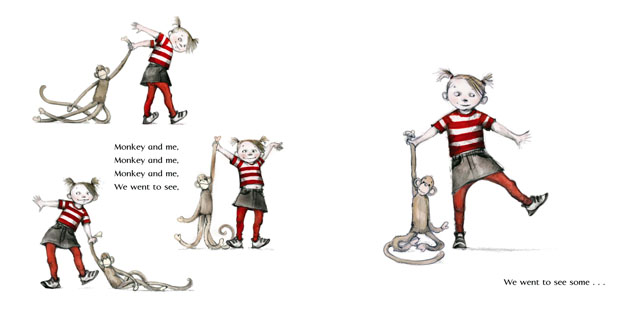
Monkey and Me is a brilliantly simple and unannounced chanted game of charades. I think this would be great fun from around six months to ages 3-4. We got it for our son when he was about one year old.

The Story
A girl and her stuffed monkey tell us about their exciting day out at the zoo by jumping up and down and posing as all the different animals they have seen for us to guess what they are. They waddle about with their feet sticking out like penguins, the girl jumps with the monkey tucked in her t-shirt like a kangaroo, they hang upside down like bats, the girl bends over and uses an arm for an elephant's trunk and they both jump and hang from things like -real- monkeys. Each picture charade has a catchy repetitive chant to go with it:

"Monkey and me
 Monkey and me
 Monkey and me
 We went to see
 We went to see some...

(Penguins/ Kangaroos/ Bats/ Elephants/ Monkeys)"

At the end, exhausted by all the excitement, the girl and her toy monkey go home for tea and fall asleep (the toy monkey too).

The Illustrations
Monkey and Me's illustrations are brimming with movement and energy and, combined with the catchy chanting, are contagious for readers and listeners.

In her pencil and watercolour illustrations on a white background, Emily Gravett uses colour sparingly and effectively (red for the girl's t-shirt and tights, grey-brown for the toy monkey and shades of brown and grey for the different animals).

The illustrations are full of plenty of little details for toddlers to notice over time. We love the stuffed monkey's facial expression, inexpressive all the way through until they start imitating the monkeys, when it turns into a broad smile, and stays that way until the end. (We love the idea of a stuffed monkey going to see real monkeys!).

In the last scene, the girl and stuffed monkey have fallen asleep at the dinner table. On the table lies a plate with a couple of chips left over, a small yoghurt pot, an uneaten open banana, a drawing of their day with the couple of pencils -red and grey, like most of the book-, they have used to draw it. A nicely subtle layer of sophistication is added by having a real monkey creep into the scene, perhaps to take the banana, while the girl and the stuffed monkey sleep.

I personally love the girl's sagging tights.

Here are some of the illustrations from Monkey and Me: 


Imitating penguins:


Imitating bats:


And a close-up of the end scene (unfortunately, I cannot find the full scene online):


Reading it out loud
Monkey and Me is a great read aloud story and game.

Young babies will appreciate the repetitive chanting. Young toddlers will enjoy recognising the animals and eventually crying out their names with each page turn. We also use it as a sort of counting book. My son thinks it's very funny when we count all 26 bats very quickly. He also seems to be about to start imitating the girl and her stuffed monkey and their animal poses.

It has a nice excitement curve, quietening down at the end, when it manages to convey that satisfied tiredness of a kid after spending a whole day out and about.


My son loves the big red fish in the beak of one of the penguins and has recently taken to imploring mercy:  'Don't eat!"

He also loves the picture of the girl and her monkey hanging upside down like bats. He likes pointing to her belly -"BELLY BUTTON!"- and saying "UPSIDE DOWN!" and turning the book upside down to see their faces properly.

Monkey and Me offers lots of opportunity for joining in, dancing to the song and playing.

Plenty, plenty of fun!


Other comments
It's nice of Emily Gravett to give us a girl with more thrill than frill in this return of the pink princess era.

Emily Gravett has a superb website, wonderfully designed, fun and informative. It includes videos of the way she works. Take a look at http://www.emilygravett.com/.

(c) of all the illustrations in this post, Emily Gravett, 2007.

Wednesday, 2 March 2011

The Little Red Fish: Whisper, whisper

The Little Red Fish by Taeeun Yoo.
Dial Books for Young Readers, Penguin, 2007.

Click on the cover to listen to the way we read The Little Red Fish. 


The Little Red Fish is a wonderfully quiet, mesmerising book, perfect for whispering out loud. Perhaps the fact that it takes place in a library, but mainly something about the dark but warm etching and hand colour illustrations, seem to make you lower your voice unconsciously when reading it out loud.

The Story
For the first time in his life, little JeJe is allowed to go to the library in the middle of the forest with his grandfather, the librarian. JeJe takes along his little red fish in its bowl to share the experience.

Amazed and excited by all those rooms lined with books, JeJe starts to explore the library from one corner to another, peeking into each room before entering. Soon he gets tired and falls asleep, to wake up in a dark and quiet room, feeling 'as though he had been swallowed up by the darkness'.

Scared and lonely, he starts reading a book to his little red fish by the light of the moon. But when he looks up, the fish bowl is empty! In his search for his little red fish, full of mystery and fear of the dark, JeJe keeps catching glimpses of its tail disappearing out of sight until he finally sees the fish disappearing into a book. JeJe picks it up and opens it and, whoosh!, the magic starts:

A sea of red fish, all the same as his, floods the library, Jeje reaches down and falls down, down into the book, where he flies over the sea with a flock of flamingos, firmly holding on to the leg of one of them, and continues to fly and drift over dreamy textless scenes before diving into the sea, rescuing his red friend and coming out of the book, safe and dry.

About to go back home, JeJe whispers to his fish that they'll be back very, very soon.  

The Illustrations
The Little Red Fish by Taeeun Yoo was the author's graduate thesis for her master's degree at the School of Visual Arts. It combines that contagious joy, ambition and excitement of first works with extraordinarily accomplished talent and natural skill at telling a story through illustrations. It is a book that would work even without the text.

I like the fact that apart from the illustrations of the actual story, the illustrations on the endpapers are also significant. The endpapers at the front and at the back are identical -an illustration of shelves full of books and interesting bits and bobs like a clock with no hands, a stuffed owl, a vase- except for the one book that is red in the back endpaper but not in the front one.

I also like the warmth provided by the red, the only actual colour used in the entire book, and the shadows of the little fish in some of the illustrations.

Another interesting thing about the illustrations, as shown in the first image below, is the use of multiple representation in a single scene, cleverly providing a sense of movement. Wonderful. 

Here are a few wonderful illustrations from The Little Red Fish (there are not that many available online, so some of our favourite ones -JeJe and his grandfather riding to the library on a bicycle with the fish bowl on the rear seat and the library in the distance along the path, for instance- are missing):

Here is JeJe exploring the library with his grandfather in the room at the back and the little fish in his bowl by his side:


Whoosh! The red fish flooding the library:


Flying with flamingos:


Back endpaper, with a rather alive looking stuffed owl, the vase, the handless clock, the ladder leaning against the shelves, and the lamp lighting up the red book:


Reading it out loud
The fact that the story and illustrations are whisper-inducing make it an excellent bedtime or quietening down story. I even sometimes whisper the story in my son's ear which he loves and finds rather amusing.

But amidst all the whispering there is also the big 'Wow!' when the fish pour out of the book and the 'Here! Here!' every time a disappearing tail is spotted.

My son always points to a particular fish in the flood scene, absolutely persuaded that it is JeJe's. 'Not this one?', we ask, pointing to any other. 'No', he'll say, with a self-assurance that suggests he sees something the rest of us miss, 'this one'.

I often read in a couple more 'downs' when he falls into the book and another 'very' at the end: 'very very soon'.

For the pages without text, I sometimes narrate what's happening, but other times just let my son look at whatever he fancies.(In the recording, because it sounded a bit odd to remain silent, I've included the kind of thing I say when I'm reading it, although this changes each time I read it):


Bits and bobs: 
This is the first book I bought for my son, so it is rather special for us. I must have been about 12 weeks pregnant and I bought it at Boston Airport on my way back from my brother's wedding. I'm so glad I did!

About a year ago, I discovered that the author, Taeeun Yoo, has a shop where she sells some of her illustrations and prints: http://www.etsy.com/shop/yoote.

Browsing through her prints, I saw she had a couple of illustrations that were part of her study piece for The Little Red Fish. So we now have on our son's bedroom wall this great illustration that was never included in the final book:

Rather special indeed, if you ask me!

(C) Copyright of all illustrations in this post, Taeeun Yoo, 2007