Lee este blog en español:
Lo leemos así

Read my other blog:

Interested in Philosophy for Children?
Showing posts with label watercolour. Show all posts

Tuesday, 21 February 2012

Amandina (or how a bored cockroach saved the show!)

Amandina, by Sergio Ruzzier
Neal Porter Books
Roaring Brook Press, 2008


Click above to listen to the way we read Amandina.

I came across Amandina while browsing through what the Neal Porter Books imprint at Roaring Brook Press (Macmillan) had published over the last few years. Being in Europe and only recently paying much attention to who actually published the children's books I read, I hadn't even heard of the imprint before reading A Sick Day for Amos McGee. Since then, I've become I bit of a stalker.

Amandina's cover, with that unassuming, long-eared, rather ugly looking small dog on a stage, draws you in at first sight. But then the inside works some serious magic and turns the initial attraction and quiet intrigue into a full blown love affair with the story of this independent-minded, talented shy dog that is the star of the show. Amandina is love at first sight that continues to grow on you with every reading.

The Story
Amandina is the story of a remarkably talented little dancer, singer, actress and acrobat dog called Amandina Goldeneyes, whose talents nobody knows about on account of her being so shy. One day, while walking on the waterfront, "as usual, all alone", Amandina decides to put an end to this silliness and give a public performance. She rents a run-down theatre, does it up herself, makes all the costumes, sets and props, puts up posters and sends out invitations announcing her very own show.

The night before the big day, Amandina dreams of a full theatre and plenty of applause. She is perfectly prepared for the big occasion, except for the curtains opening and finding that nobody had turned up. She wonders what to do for a moment, but then decides to go ahead with it all anyway. She starts with a fanciful prologue. A cockroach who is wandering around "with no plans for the evening" sees the beginning of her fantastic show and calls up all his friends, who arrive and watch the rest of the show in silent awe: a comic pantomime, a shortened version of Beauty and the Beast, a band concert, folk songs and dances from all over the world, a magic act, "and a stupendous acrobatic feat as a grand finale". When Amandina raises her head after her bow at the end, and hears the thunderous applause coming from the packed venue, she's a very happy pup.

The Illustrations
Sergio Ruzzier's pen & ink and watercolour illustrations stand out instantly as having a marked personality of their own and a definite recognisability. He uses colour beautifully, with a recurring warm but muted palette of green, blue, cream, ochre, pinky-red and orange, which in all likelihood appear rather brighter on your screen than on the beautifully thick paper in the book. Even so, I think the richness of the illustrations can be appreciated on screen.

Voilà Amandina Goldeneyes in the opening scene (is that not a particularly nice green?):
And here's the old theatre she does up single-handedly:


Here is Amandina cutting the cloth for her costumes:


The heartbreakingly empty theatre:


Check out the "fanciful prologue"! (and the beautiful blue)

And this "shortened version of Beauty and the Beast" does look rather appealing: 


The band concert:


Folk singing and dancing:


I could just go on reproducing them all! Each and every illustration in Amandina has something special about it, but it's only fair to leave something to the imagination. I personally love the scene with the cockroach sitting on a seat after having emerged from a tear in the tapestry. And the last scene with all the audience cheering and Amandina holding up a flower in triumph is fantastic. Judge for yourselves, but I think you'll agree they are special.

Reading it out loud
Amandina is proof that although rhyme, rhythm and the opportunity to put on silly voices help when it comes to reading to children (I'm talking of very young children here), if the story is powerful and intriguing enough and the character is developed powerfully through the illustrations, they are by no means prerequisites for toddler read-aloud enjoyment.

Of course, the musicality of the heroine's name, Amandina Goldeneyes, doesn't hurt. The very mention of it makes my son smile.

But reading Amandina out loud is perhaps more about sharing the illustrations, pointing out the little details and being captivated by the little dog herself, a really solidly developed character my son took to immediately, from the moment he saw the cover.

My son (now approaching three) loves looking and commenting on all the scenes where Amandina is preparing the theatre and the show. "What's she doing here?" "And here?" "And here?". He loves the animals in the dream scene, which include a bear, a flamingo, an elephant, a lion, a deer, a crocodile and a couple of dolphins. "Where's the water?". He absolutely loves the scene of Amandina's girl-like feet sticking out under the stage curtains. He asks "What happened?" when he sees the empty theatre and chuckles when he sees the cockroach. And of course, he loves joining in the cheering and the applauding at the end.

Amandina is a quiet book that causes noisy celebration.

Other things we like about Amandina
Amandina was an instant hit with parents and 2.5 year old son alike. More about why the adults in the house liked it below, but I venture to say why my son was so immediately drawn to this funny little dog:  Amandina's eyes are not just human-like, they are unmistakeably child-like in their expression of uncertainty, determination, concern, concentration and enjoyment. I'm sure children pick up on this immediately.

Adults in the house like Amandina because it manages to tell a story about confronting shyness or insecurity without sending out big messages or being cheesy. We also like to look at it as a hymn to keeping at it, to doing what you like and what you want to do, even if no one is listening or paying attention. You never know what cockroaches might be lurking behind your sofa.

Read more about Sergio Ruzzier in this interview from 2008 by Jules Danielson over at Seven Impossible Things Before Breakfast.


(c) of all the illustrations in this post, Sergio Ruzzier, 2008.
(c) of the text, Ellen Duthie. You may copy this or reproduce it, but please be nice and credit the author and the site.

Thursday, 14 April 2011

Monkey and Me: Time for Charades!

Monkey and Me, by Emily Gravett, 2007.
Our edition: Macmillan Children's Books, 2010.
Click on the cover to listen to the way we read Monkey and Me by Emily Gravett. 


Click here to listen to how we sometimes read it like a counting book: 


Monkey and Me is a brilliantly simple and unannounced chanted game of charades. I think this would be great fun from around six months to ages 3-4. We got it for our son when he was about one year old.

The Story
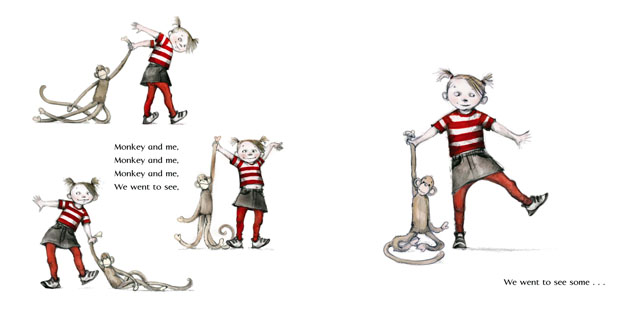
A girl and her stuffed monkey tell us about their exciting day out at the zoo by jumping up and down and posing as all the different animals they have seen for us to guess what they are. They waddle about with their feet sticking out like penguins, the girl jumps with the monkey tucked in her t-shirt like a kangaroo, they hang upside down like bats, the girl bends over and uses an arm for an elephant's trunk and they both jump and hang from things like -real- monkeys. Each picture charade has a catchy repetitive chant to go with it:

"Monkey and me
 Monkey and me
 Monkey and me
 We went to see
 We went to see some...

(Penguins/ Kangaroos/ Bats/ Elephants/ Monkeys)"

At the end, exhausted by all the excitement, the girl and her toy monkey go home for tea and fall asleep (the toy monkey too).

The Illustrations
Monkey and Me's illustrations are brimming with movement and energy and, combined with the catchy chanting, are contagious for readers and listeners.

In her pencil and watercolour illustrations on a white background, Emily Gravett uses colour sparingly and effectively (red for the girl's t-shirt and tights, grey-brown for the toy monkey and shades of brown and grey for the different animals).

The illustrations are full of plenty of little details for toddlers to notice over time. We love the stuffed monkey's facial expression, inexpressive all the way through until they start imitating the monkeys, when it turns into a broad smile, and stays that way until the end. (We love the idea of a stuffed monkey going to see real monkeys!).

In the last scene, the girl and stuffed monkey have fallen asleep at the dinner table. On the table lies a plate with a couple of chips left over, a small yoghurt pot, an uneaten open banana, a drawing of their day with the couple of pencils -red and grey, like most of the book-, they have used to draw it. A nicely subtle layer of sophistication is added by having a real monkey creep into the scene, perhaps to take the banana, while the girl and the stuffed monkey sleep.

I personally love the girl's sagging tights.

Here are some of the illustrations from Monkey and Me: 


Imitating penguins:


Imitating bats:


And a close-up of the end scene (unfortunately, I cannot find the full scene online):


Reading it out loud
Monkey and Me is a great read aloud story and game.

Young babies will appreciate the repetitive chanting. Young toddlers will enjoy recognising the animals and eventually crying out their names with each page turn. We also use it as a sort of counting book. My son thinks it's very funny when we count all 26 bats very quickly. He also seems to be about to start imitating the girl and her stuffed monkey and their animal poses.

It has a nice excitement curve, quietening down at the end, when it manages to convey that satisfied tiredness of a kid after spending a whole day out and about.


My son loves the big red fish in the beak of one of the penguins and has recently taken to imploring mercy:  'Don't eat!"

He also loves the picture of the girl and her monkey hanging upside down like bats. He likes pointing to her belly -"BELLY BUTTON!"- and saying "UPSIDE DOWN!" and turning the book upside down to see their faces properly.

Monkey and Me offers lots of opportunity for joining in, dancing to the song and playing.

Plenty, plenty of fun!


Other comments
It's nice of Emily Gravett to give us a girl with more thrill than frill in this return of the pink princess era.

Emily Gravett has a superb website, wonderfully designed, fun and informative. It includes videos of the way she works. Take a look at http://www.emilygravett.com/.

(c) of all the illustrations in this post, Emily Gravett, 2007.

Monday, 7 March 2011

A Taste of the Moon. To us, it tastes of cheese and broccoli

A Taste of the Moon by Michael Grejniec. Kalandraka, 2010. 
Original title in German: Wie schmeckt der Mond?, Bohem Press, 1993.
Our edition: ¿A qué sabe la luna? (Kalandraka Editora, 1999), translated by Carmen Barreiro. 

Click on the image to listen to the way we read A Taste of the Moon (in Spanish).

(This review refers to the Spanish edition)
A Taste of the Moon is a fable about co-operation, the advantages of being insignificant in size and appearance, and perspective, with a dash of humour provided by a playful moon. We like it!

The story
The animals had long wanted to find out what the moon tasted like. The would look up at the sky wistfully, stretching out as far as they could, but none of them could reach it. 

One day the tortoise decided to climb the tallest mountain, determined to reach the moon. Up there, the moon was indeed closer, but still a little too far to reach. So the tortoise called the elephant, who climbed up on top of the tortoise to see whether they could touch it. The moon took it as a game and decided to move away a little, and the elephant could not reach either. So they started calling all the other animals, one by one, until forming an unlikely tower with the tortoise at the base, followed by the elephant, the giraffe, the zebra, the lion, the fox, the monkey... and each time the moon saw another animal arrive, it moved away just a little bit more to stop them from reaching.


Finally, the monkey, who was so close he could smell the moon, called the mouse. When the moon saw the mouse she said to herself 'Such a small animal will never reach me'. And she stayed where she was. So the mouse climbed up the tower of animals and -at last!- managed to tear off a small piece of the moon. It then passed down a piece of the moon to each of the other animals below. And what did it taste of? It tasted of what each of them liked best. After their formidable feat, the animals huddled together and went to sleep.  

The fable ends with a fish looking at the moon in the water, flip-turning our perspective in the form more of an epilogue than a moral. 

The illustrations
The illustrations made with watercolour on papier maché create a fantastic illusion of three dimensions and  a texture that seems almost edible. 

We really like both the scenes of the animals and the moon against the black background of night and the illustrations of the animals arriving on the white background of the text page. 

These are the rather charming characters of A Taste of the Moon:


The tortoise, who bears the weight,
not of the world like in the Hindu myth,
but of a rather impressive tower.

The elephant


The giraffe


The zebra

The lion. We love this lion!


The fox


The monkey
And our great little hero, the mouse. 


Here are the base of the tower and the finished tower: 


And, at last, the bite:


Reading it out loud: 

Like with many traditional tales and stories, A Taste of the Moon has a repetitive, cumulative structure that is perfect for captivating small ears.  

We always call out for each animal to come: 'Elephaaant! Elephaaant!', Giraaaaaffe! Giraaaaffe' which encourages our son to take part in the narration. He loves calling out for them all!

When, at long last, the animals are savouring the pieces of moon, tasting of whatever they like best, we explain to our son that for him the moon would taste of cheese and broccoli, which are the two things that he never, ever, ever turns down.

There are also a couple of things we change that apply only to the Spanish version which I don't see the point of going into here. (If interested and you read Spanish, you can read it here.)

Other things we like about it
One thing I particularly like about A Taste of the Moon is that instead of ending with a facile moral, it closes with a nice question about how perspective affects our view of the world and the way we interact with it.

I think this one is going to be a book with a long shelf life.  

(c) of all illustrations in this post, Michael Grejniec, 1993. 

Friday, 25 February 2011

Where the Wild Things Are: Let the wild rumpus start!

Where the Wild Things Are by Maurice Sendak, 1963.
Our edition: The Bodley Head, London, 1993, reprinted 2008. 

One of our absolute favourites, Where the Wild Things Are, has a delightfully dreamlike, gripping text, with terrific pace, rhythm and musicality, combined with stunning pen and ink and watercolour illustrations that draw you into Max's world and make you want to leap up and dance the wild rumpus every time. It is a joy to read out loud.

The Story
Where the Wild Things Are is a journey of a little boy called Max from the solitary confinement of his bedroom, where he has been sent 'without eating anything' for what would now be termed some 'time-out', to the land where the the Wild Things are and then back to the cosiness of his bedroom and the warmth of his supper.

The story opens with Max dressed in a wolf suit, running about his house making mischief until he gets sent to bed without any supper. In the loneliness of his bedroom, Max dreams up a leafy world of thick forest that takes him on a boat 'through night and day and in and out of weeks and almost over a year to where the wild things are'. Here he is met by a group of apparently fearful roar-roaring, teeth--gnashing, eye-rolling, claw-showing monsters. Max manages to tame them 'by staring into all their yellow eyes without blinking once' and these creatures -upon closer inspection, charmingly goofy and altogether harmless- immediately make him King of all Wild Things. A wild rumpus ensues until Max orders them all to stop and sends them off to bed without their supper. Suddenly the boy feels lonely and not quite as wild anymore. So he gives up being king of all wild things and decides to sail back to his room, where he finds his supper waiting for him, 'still hot'.

What a wonderful description of a tantrum!

The Illustrations
Here are some of our favourite illustrations from the book:

In this one, we like the drawing of the monster on the wall, signed Max. 


In this one, we love Max's face, defying anger and boredom with imagination:


And this one is our favourite wild rumpus scene: 

One of the many little details I like is that the first few illustrations in the book are set within a frame, which gradually gets narrower with each page, as Max imagination takes hold, until it disappears altogether and the illustration covers the entire page. I like the fact that reality starts off framed and, after passing through the sieve of imagination, ends up frameless and fuller.  

Reading it out loud
We bought this for our son before he was born, and read it to him almost from the start. 

It is one of those texts that flows effortlessly out of your mouth from the very first time you read it. Even as a very young baby, our son seemed to enjoy it, perking up with each exclamation mark and listening to the soft rolling musicality of other parts. 

The first bits that caught his attention and made him laugh were of course the BE STILL! and the "NOW STOP! accompanied by suitably exaggerated authoritarian hand gestures and facial expressions, and obviously the wild rumpus, for which we made interesting drumming sounds, drawing it it out for a bit longer than usual. 

By the time he had learnt how to ask us to read bits again, he was into the monsters roaring their terrible roars and gnashing their terrible teeth and rolling their terrible eyes and showing their terrible claws again and again and again. 

Now, at 23 months, he still loves the wild rumpus and the roaring and the gnashing but he also loves the fact that his nosh was still hot at the end.

We always say ‘nosh’ instead of ‘supper’ when we read it (except in the recording, where we must have felt we had to read it like it was).

I'd just like to make clear that this recording is not meant to set the standard for any future recordings provided! Other recordings will have no fancy music and will normally just be boring old me reading them. This particular recording was a present to my son from "Los Reyes" (The Three Kings, or the Three Wise Men, who bring Spanish children their presents on the 6th of January). 

(C) Copyright of all illustrations in this post, Maurice Sendak, 1963
(C) Copyright of the text, Ellen Duthie. By all means copy it or reproduce it, but please be nice and cite your source (author and site).

More reviews and readings of books by Maurice Sendak on We Read It Like This: