Lee este blog en español:
Lo leemos así

Read my other blog:

Interested in Philosophy for Children?
Showing posts with label babies. Show all posts

Wednesday, 26 June 2013

Cultural, literary and linguistic hodgepodge: the odd couple of bedtime or how the Ahlbergs meet Lorca

Each Peach Pear Plum
Janet and Allan Ahlberg
First published in 1978
While writing the next 'proper' long review for We Read it Like This about a wonderful, amusing and playful character who's a firm favourite of ours (Javier Sáez Castán's "little king" or "pequeño rey" -click here to take a look), I felt it was time to write a post I have been thinking of writing for ages but couldn't quite work out how to go about it. 

It's slightly difficult to classify as a post, but it is after all an important part of what this blog is about: keeping a record of how we read our favourite books. Our family is culturally, linguistically and literarily bilingual and therefore how we read the things we like is rather influenced and mediated by this fact. There is one book in particular we have been reading to our son practically since he was born (it was a present from his maternal grandparents). It is the classic Each Peach Pear Plum, by Janet and Allan Ahlberg (authors of the also fantastic The Jolly Postman and Peepo! among many other great hits). The book is  based on a very simple idea, the kind that is so difficult to execute convincingly and smoothly. In Each Peach Pear Plum the execution of the idea is so masterful that we are made to feel it was a piece of cake. It is a chained rhyme, an "I spy" game and a "Where's Wally?", all in one. Characters from traditional stories (Tom Thumb, Cinderella, the three bears, Robin Hood, the wicked witch) and from nursery rhymes (Baby Bunting, Mother Hubbard, Jack and Jill...) are peppered throughout the book, first hidden (where we are invited to play "I spy") and then unveiled on the following page.

Tom Thumb "hidden"
Tom Thumb in full view and Mother Hubbard hidden 

At the end they all come out of their hiding -Ta-daaah!- and sit down to enjoy the plum pie. Yum yum.  


Its gentle, rolling rhythm make it a perfect book to read from birth and also for non-native speakers of English. It is a great way of getting familiar with the rhythm and musicality of the English language, as well as getting to know the characters of many traditional nursery rhymes. The perfect excuse for going off and finding each of the nursery rhymes all the characters originally appear in.  

For us, reciting the text (it's very easy to learn by heart because the last words of each page are the first words of the following page) has become an essential part of our bedtime routine. When we have finished reading whatever stories or chapter book we are reading on any given night, it's lights off and Each Peach Pear Plum. The comforting familiarity of the rhyme guarantees a certain small boy will be asleep before the end of it. We have been following this ritual for at least three years and there's no indication that it's about to stop any time soon. 

But Each Peach Pear Plum rarely goes without its odd couple before it. Enter our peculiar and very natural cultural and linguistic hodgepodge: It turns out that also from when he was very young, I have sung my son a lullaby in Spanish, taken from Federico García Lorca's Blood Wedding and then adapted and sung hair-raisingly by Camarón, considered to be the best flamenco singer of all times. The lullaby is called Nana del caballo grande (Lullaby of the Big Horse) and I sing it a lot more quietly and with rather less duende than Camarón, I'm sure, but  I think I must have started singing it because it was the only lullaby I knew the lyrics for in Spanish. So that is how we got to our full routine. Lights off, Lullaby of the Big Horse followed without interruption by Each Peach Pear Plum. Three years of this odd couple at bedtime. Here's to making sure we never forget how strangely well they go together:


Here's a quick translation of the adapted version of Lorca's Lullaby of the Big Horse as sung by Camarón. The translation is meant to fit the song (more or less) rather than to be faithful to Lorca's version within Blood Wedding. Enjoy. 

Hush,my baby, hush now
Listen to the lullaby
The big horse came and would not drink  
The big horse came and would not drink.

The water was a deep dark black
Right under the branches.
When it came up to the bridge
The horse, it stopped and sang like this: 

Aaaaaay aaaaay aaaay aaay aaa

Who is to say, my baby,
What is in this water,
With its long, long, long, long tail
Along its green, green, green green hall?

Aaaaaay aaaaay aaaay aaay aaa

Sleep, carnation, sleep,
The horse is not willing to drink.

Sleep, my rose, sleep now,  
The horse is starting to weep.


(c) of all the illustrations in this post, Janet Ahlberg, 1978. 
(c) of the text and translation, Ellen Duthie. You may copy this or reproduce it, but please be nice and credit the author and site. 

Sunday, 4 September 2011

We're Going on A Bear Hunt: Hoooo woooo! Hoooo woooo!

We're Going on a Bear Hunt, by Michael Rosen (writer)
& Helen Oxenbury (illustrator), Walker Books, 1989.
Our edition: Walker Books, 1997.

Click on the cover to listen to the way we read We're Going on a Bear Hunt by Michael Rosen and Helen Oxenbury.


We're Going on a Bear Hunt is a family adventure of playful bravery, evocative noises and giggly fear.

The Story
Based on an old campfire song, We're Going on a Bear Hunt tells the story of a family (refreshingly, a father with four kids and a dog) that sets out one morning on an adventure to catch a bear. They are determined ("We're going on a bear hunt"), confident (We're going to catch a big one), optimistic ("What a beautiful day!") and fearless ("We're not scared").

On the way, they encounter all sorts of obstacles they "can't go over and can't go under" but just have to "go through", and, luckily, they all make interesting noises. These obstacles include a field of long wavy grass (swishy swashy), a deep cold river (splash splosh), a field of thick oozy mud (squelch squerch), a big dark forest (stumble trip!), a swirling whirling snowstorm (Hoooo woooo!) and finally a narrow gloomy cave (tiptoe! tiptoe!).

Waiting for them in the cave is the last thing they expect to find. An actual bear! They all turn around and run out, having to make their way back through all the obstacles in reverse order, making all those funny noises again, but far more quickly and with the bear running after them, back to their front door and eventually into bed and under the covers with the determination never to go on a bear hunt again.

The Illustrations
Helen Oxenbury's pencil and watercolour illustrations, alternating colour and black and white double page spreads, bring to life this family's day out, with a perfect rendering of that combination of excitement and contented exhaustion children tend to display on a day out.

We're Going on a Bear Hunt has wonderful movement scenes:

Splash splosh


Oh no! We forgot to close the door!

And just as great scenes of the family at rest in between obstacles:


We like the faces of them all when they enter into the cave:
Tiptoe! Tiptoe!


And when they get to the bedroom. Aaaah!


Our son loves the scene where they are under the blanket, particuarly the head poking out in the bottom left hand corner and the safe teddy-bear the baby is playing with:


And we all like the last scene, of course, with the bear walking back alone, looking more like he's in need of a friend than a bite to eat:


Reading it Aloud
We're Going on a Bear Hunt is written to be recited or sung out loud.

We did not know the song it is based on and I confess we found it hard to find a comfortable rhythm to it at the very start. It somehow seemed to fall flat. However after a few readings, we made it our own and our son has loved it ever since (we bought it when he was around 15 months).

It has all the perfect elements to be read aloud to young kids: repetition (both words and rhythm), plenty of interesting sounds, and a sudden change in tempo which breaks the tension and brings on a wonderful comic effect that gets children giggling every time, before it all calms down again right at the end. And on top of all that, the chance -almost the compulsion- for the child to join in, with voice or body or both.

We sometimes read it "quietly" and concentrate on the sounds (like in the recording), or read it more actively, acting it out, moving our hands through the grass while we say swishy swashy, pretending to swim through the splash splosh, getting up and walking in the squelch squerchy mud and pretending to stumble and trip through the forest, before shivering through the snowstorm and tiptoeing into the cave and then doing it all in reverse order on the way back!

Whether we are reading it quietly or actively, we always move our arms to:

We can't go over it.
We can't go under it. 
Oh no!
We've got to go through it!


A couple of interesting We're Going on a Bear Hunt videos:

Check out this lightly animated version of the story:


And Michael Rosen himself telling it: 

(c) of all the illustrations in this post: Helen Oxenbury, 1989.

Thursday, 14 April 2011

Monkey and Me: Time for Charades!

Monkey and Me, by Emily Gravett, 2007.
Our edition: Macmillan Children's Books, 2010.
Click on the cover to listen to the way we read Monkey and Me by Emily Gravett. 


Click here to listen to how we sometimes read it like a counting book: 


Monkey and Me is a brilliantly simple and unannounced chanted game of charades. I think this would be great fun from around six months to ages 3-4. We got it for our son when he was about one year old.

The Story
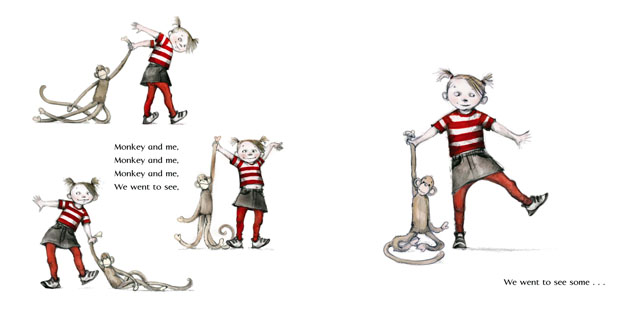
A girl and her stuffed monkey tell us about their exciting day out at the zoo by jumping up and down and posing as all the different animals they have seen for us to guess what they are. They waddle about with their feet sticking out like penguins, the girl jumps with the monkey tucked in her t-shirt like a kangaroo, they hang upside down like bats, the girl bends over and uses an arm for an elephant's trunk and they both jump and hang from things like -real- monkeys. Each picture charade has a catchy repetitive chant to go with it:

"Monkey and me
 Monkey and me
 Monkey and me
 We went to see
 We went to see some...

(Penguins/ Kangaroos/ Bats/ Elephants/ Monkeys)"

At the end, exhausted by all the excitement, the girl and her toy monkey go home for tea and fall asleep (the toy monkey too).

The Illustrations
Monkey and Me's illustrations are brimming with movement and energy and, combined with the catchy chanting, are contagious for readers and listeners.

In her pencil and watercolour illustrations on a white background, Emily Gravett uses colour sparingly and effectively (red for the girl's t-shirt and tights, grey-brown for the toy monkey and shades of brown and grey for the different animals).

The illustrations are full of plenty of little details for toddlers to notice over time. We love the stuffed monkey's facial expression, inexpressive all the way through until they start imitating the monkeys, when it turns into a broad smile, and stays that way until the end. (We love the idea of a stuffed monkey going to see real monkeys!).

In the last scene, the girl and stuffed monkey have fallen asleep at the dinner table. On the table lies a plate with a couple of chips left over, a small yoghurt pot, an uneaten open banana, a drawing of their day with the couple of pencils -red and grey, like most of the book-, they have used to draw it. A nicely subtle layer of sophistication is added by having a real monkey creep into the scene, perhaps to take the banana, while the girl and the stuffed monkey sleep.

I personally love the girl's sagging tights.

Here are some of the illustrations from Monkey and Me: 


Imitating penguins:


Imitating bats:


And a close-up of the end scene (unfortunately, I cannot find the full scene online):


Reading it out loud
Monkey and Me is a great read aloud story and game.

Young babies will appreciate the repetitive chanting. Young toddlers will enjoy recognising the animals and eventually crying out their names with each page turn. We also use it as a sort of counting book. My son thinks it's very funny when we count all 26 bats very quickly. He also seems to be about to start imitating the girl and her stuffed monkey and their animal poses.

It has a nice excitement curve, quietening down at the end, when it manages to convey that satisfied tiredness of a kid after spending a whole day out and about.


My son loves the big red fish in the beak of one of the penguins and has recently taken to imploring mercy:  'Don't eat!"

He also loves the picture of the girl and her monkey hanging upside down like bats. He likes pointing to her belly -"BELLY BUTTON!"- and saying "UPSIDE DOWN!" and turning the book upside down to see their faces properly.

Monkey and Me offers lots of opportunity for joining in, dancing to the song and playing.

Plenty, plenty of fun!


Other comments
It's nice of Emily Gravett to give us a girl with more thrill than frill in this return of the pink princess era.

Emily Gravett has a superb website, wonderfully designed, fun and informative. It includes videos of the way she works. Take a look at http://www.emilygravett.com/.

(c) of all the illustrations in this post, Emily Gravett, 2007.

Saturday, 26 March 2011

Tiddler, The Story-Telling Fish: OH, YES, HE DID!

Tiddler. The Story-Telling Fish. Julia Donaldson and Axel Scheffler, 2007.
Alison Green Books, Scholastic Children's Books, 2010.


Click above to listen to the way we read Tiddler, The Story-Telling Fish. 

I have gradually come round to thinking this may be one of the best stories for reading aloud to under two-year-olds (and over) we have. It has a flowing, effortless rhythm, becoming almost a gentle rap when you read it out loud, plus plenty of repetition and opportunities to join in.

The story
Tiddler is a little fish that "blows small bubbles but tells tall tales". Every day he arrives late for fish school and every day his excuse is a taller tale, ranging from having been riding on a seahorse to having been trapped in a treasure chest and set free by a mermaid. At school nobody really believes him except impressionable Little Johnny Dory, who is so excited by his stories that he tells them to his granny, who in turn tells them to a plaice, and thus the stories are spread across the ocean. One day while dreaming up his next fantasy, he actually gets to live a real adventure of his own. Poor little Tiddler gets fished!

Fortunately, the fishermen throw him back because he is too small, but Tiddler is lost, frightened and does not know how to get back. But then he hears a rather familiar story about himself being chanted by a shoal of anchovies, and follows the story across the ocean from shrimp to whale to herring to eel to lobster to seal, back home and to his classroom, where, as always, nobody believes him except Little Johnny Dory, who does something rather special for Tiddler at the end.  

The Illustrations
Axel Scheffler's vivid and colourful pen, ink and pencil illustrations, full of detail and expressiveness, really come to life in Tiddler.

By the time we got Tiddler, my son was already acquainted with Scheffler's illustrations from The Gruffalo and Room on the Broom, so he took to these immediately. We really like all the different types of fish and all the sea life -Tiddler was responsible for my son's octopus and shark phase- and the fish school scenes are very good fun. And then of course, there is the gruffalo fish that pops up midway through the book. I think it was one of the first times I saw my son laugh for a reason other than tickling or hearing a funny noise.

Here are some illustrations from Tiddler:

Opening  double page spread, with Tiddler at the centre of the first page
and some of his excuses for arriving late portrayed on the second page


Mermaid rescuing Tiddler with a shark lurking about


Granny Dory telling Tiddler's story to her friend the plaice


Tiddler being captured by the net!


Reading it out loud

When we first got Tiddler, and the first couple of times I read it, I have to say I was not too sure about it. There was something about the story, in particular the ending, that seemed to fall flat. But the more we read it out loud, the more we got into the flowing rhythm and the more our son enjoyed it. It has a wonderful musicality and a few nice repetitive structures for small listeners to join in. It quickly became one of our favourites.

Tiddler was our son's first goodnight story. We always read other bedtime stories before, on the sofa, but Tiddler was the first story we took into his own bedroom to read to him just before he dropped off to sleep.

One of the interesting things about reading it out loud is the different effects it can have depending on the speed at which you read it. Because it was our son's goodnight story every single night for a good few months, we realised that when he was very tired we were reading it to him very quickly, almost rapping it. Perfect for a sleepy boy. But then other times, for more alert moods, we read it more slowly and allow time for stopping, looking, pointing and joining in. The recording is probably somewhere in between:


Our son joins in every time Miss Skate calls the register at fish school:
"Tiddler? Tiddler? TIDDLER'S LATE!":


And in every "Oh no, s/he didn't", "OH, YES, S/HE DID"!


Other comments
Since the Tiddler months, we have had briefer bedtime flirts with Eric Carle's The Very Quiet Cricket, Donaldson and Scheffler's The Snail and the Whale, and Sam McBratney and Anita Jeram's Guess How Much I Love You, a very long love story with Maurice Sendak's The Nutshell Library every single night for months and, a recent move, on to The Boy in the Garden by Allen Say, but I'm sure he'll return to Tiddler at some point.


Tiddler is "The boy who cried wolf" (in fact it was even released in some places as The fish who cried wolf) with the moral refreshingly left out.

I'm still not sure about the ending, though.

(c) of all illustrations in this post, Axel Scheffler, 2007.