Lee este blog en español:
Lo leemos así

Read my other blog:

Interested in Philosophy for Children?
Showing posts with label rhyme. Show all posts

Wednesday, 26 June 2013

Cultural, literary and linguistic hodgepodge: the odd couple of bedtime or how the Ahlbergs meet Lorca

Each Peach Pear Plum
Janet and Allan Ahlberg
First published in 1978
While writing the next 'proper' long review for We Read it Like This about a wonderful, amusing and playful character who's a firm favourite of ours (Javier Sáez Castán's "little king" or "pequeño rey" -click here to take a look), I felt it was time to write a post I have been thinking of writing for ages but couldn't quite work out how to go about it. 

It's slightly difficult to classify as a post, but it is after all an important part of what this blog is about: keeping a record of how we read our favourite books. Our family is culturally, linguistically and literarily bilingual and therefore how we read the things we like is rather influenced and mediated by this fact. There is one book in particular we have been reading to our son practically since he was born (it was a present from his maternal grandparents). It is the classic Each Peach Pear Plum, by Janet and Allan Ahlberg (authors of the also fantastic The Jolly Postman and Peepo! among many other great hits). The book is  based on a very simple idea, the kind that is so difficult to execute convincingly and smoothly. In Each Peach Pear Plum the execution of the idea is so masterful that we are made to feel it was a piece of cake. It is a chained rhyme, an "I spy" game and a "Where's Wally?", all in one. Characters from traditional stories (Tom Thumb, Cinderella, the three bears, Robin Hood, the wicked witch) and from nursery rhymes (Baby Bunting, Mother Hubbard, Jack and Jill...) are peppered throughout the book, first hidden (where we are invited to play "I spy") and then unveiled on the following page.

Tom Thumb "hidden"
Tom Thumb in full view and Mother Hubbard hidden 

At the end they all come out of their hiding -Ta-daaah!- and sit down to enjoy the plum pie. Yum yum.  


Its gentle, rolling rhythm make it a perfect book to read from birth and also for non-native speakers of English. It is a great way of getting familiar with the rhythm and musicality of the English language, as well as getting to know the characters of many traditional nursery rhymes. The perfect excuse for going off and finding each of the nursery rhymes all the characters originally appear in.  

For us, reciting the text (it's very easy to learn by heart because the last words of each page are the first words of the following page) has become an essential part of our bedtime routine. When we have finished reading whatever stories or chapter book we are reading on any given night, it's lights off and Each Peach Pear Plum. The comforting familiarity of the rhyme guarantees a certain small boy will be asleep before the end of it. We have been following this ritual for at least three years and there's no indication that it's about to stop any time soon. 

But Each Peach Pear Plum rarely goes without its odd couple before it. Enter our peculiar and very natural cultural and linguistic hodgepodge: It turns out that also from when he was very young, I have sung my son a lullaby in Spanish, taken from Federico García Lorca's Blood Wedding and then adapted and sung hair-raisingly by Camarón, considered to be the best flamenco singer of all times. The lullaby is called Nana del caballo grande (Lullaby of the Big Horse) and I sing it a lot more quietly and with rather less duende than Camarón, I'm sure, but  I think I must have started singing it because it was the only lullaby I knew the lyrics for in Spanish. So that is how we got to our full routine. Lights off, Lullaby of the Big Horse followed without interruption by Each Peach Pear Plum. Three years of this odd couple at bedtime. Here's to making sure we never forget how strangely well they go together:


Here's a quick translation of the adapted version of Lorca's Lullaby of the Big Horse as sung by Camarón. The translation is meant to fit the song (more or less) rather than to be faithful to Lorca's version within Blood Wedding. Enjoy. 

Hush,my baby, hush now
Listen to the lullaby
The big horse came and would not drink  
The big horse came and would not drink.

The water was a deep dark black
Right under the branches.
When it came up to the bridge
The horse, it stopped and sang like this: 

Aaaaaay aaaaay aaaay aaay aaa

Who is to say, my baby,
What is in this water,
With its long, long, long, long tail
Along its green, green, green green hall?

Aaaaaay aaaaay aaaay aaay aaa

Sleep, carnation, sleep,
The horse is not willing to drink.

Sleep, my rose, sleep now,  
The horse is starting to weep.


(c) of all the illustrations in this post, Janet Ahlberg, 1978. 
(c) of the text and translation, Ellen Duthie. You may copy this or reproduce it, but please be nice and credit the author and site. 

Thursday, 21 April 2011

The Nutshell Library: Care!

The Nutshell Library, by Maurice Sendak, 1962. HarperCollins. (Includes: Pierre, a cautionary tale in five chapters and a prologue; Chicken Soup with Rice, A Book of Months; One was Johnny, A Counting Book and Alligators all Around, An Alphabet).
          

Listen to the way we read them:


The Nutshell Library is a collection of four miniature book gems that fit perfectly into little hands. Each of the four books that comprise it is also available in a larger format, but I think that misses part of the point as to why they are so much fun and why children take to them immediately.

We bought these for our son when he was about 21 months old and he has since had a full on love affair with all of them together and with each of them separately, in turns. His absolute favourite does seem to be Pierre though.

1. Pierre, a cautionary tale in five chapters and a prologue 


"I can eat you, don't you see?"
"I don't care!"
Described on the miniature dust-jacket as 'A story with a moral air about Pierre, who learned to care', Pierre is basically the story of a little brat whose reply to anything he is asked or told is: 'I don't care!'. Even when his parents leave him at home and a lion comes along and looks him 'right in the eye and asks him if he'd like to die', Pierre answers "I don't care!". So the lion eats him. 

Of course, all ends well, and eventually Pierre is shaken out of the lion in one piece by a doctor remarkably strong for his size.

Relieved that he isn't dead and wanting to be taken home, Pierre's answer to the lion's offer to give them a ride ('If you would care to climb on me, I'll take you there') is, to the great relief of his parents: 'Yes, indeed I care!!'. This delightfully playful short story in rhyme ends with a moral:

"The moral of Pierre is: CARE!"

Here are a couple of scenes from Pierre (don't you like the expression on his face?):
"Good morning darling boy,
you are my only joy"
"I don't care!"

"Don't sit backwards on your chair."
"I dont' care!"
"Or pour syrup in your hair."
"I don't care!"

What we like about Pierre
Pierre's effortlessly musical rhythm really is something special. The repetion of "I don't care" throughout the rhymed poem has a powerful effect on how the mind focuses on the rest of the text, and somehow learns it after just a few readings. In fact, Pierre is the first book my son learnt 'by heart' (if you stopped, he would fill in the next word). What was most remarkable was how quickly this happened (within a few days). Reading other reviews and comments, this appears to be a common occurrence with Pierre (and with the other Nutshell Library books too). I suppose you might just call it catchy, except that catchy usually refers to the refrain or a particular part of a song or poem. This is the whole thing!

I also love the refreshingly casual, playful and unthreatening introduction of the subject of death, already mentioned above, with the lion asking Pierre whether he'd like to die, and suggesting it might be a way of not having to put up with his parents.

"I can eat you, don't you see?"
"I don't care!"
"And you will be inside of me."
"I don't care!"
"Then you'll never have to bother-"
"I don't care!"
"With a mother and a father."
I don't care!"
[...] So the lion ate Pierre.


And then, at the end, when the lion gives "a roar and Pierre falls out upon the floor":

"He rubbed his eyes
and scratched his head
and laughed
because he wasn't dead".


I especially like the way Pierre gives brats a loving literary slap.


2. Chicken Soup with Rice, A Book of Months


'Each month is gay
each season nice,
when eating
chicken soup
with rice".


In this catchy, fun little ode to chicken soup with rice and its endless possibilities, a boy with an uncanny resemblance to Pierre takes us through a year of chicken-soup-with-rice madness, with a poem and illustration for each month of the year.

The scenes for each month include wonders such as sipping hot chicken soup with rice while slipping on the sliding ice, celebrating the boy's snowman's anniversary with "cake for him and soup for me", becoming "a robin lightly dressed" concocting soup inside his nest, pepping up some droopy roses with a drop of chicken soup (we love this one!), becoming a cooking pot cooking soup, riding a crocodile down the soupy Nile, becoming a whale and spouting hot soup and becoming a baubled bangled Christmas tree with soup bowls draped all over him.

Here are some of these great little scenes:


One of our absolute favourites!


That refrain at the end is just so catchy!

What we like about Chicken Soup with Rice
We like the frolicking imagination in Chicken Soup with Rice: thinking it best to become a "robin lightly dressed concocting soup", becoming a cooking pot, and becoming a Christmas tree are fantastic images!

What our son liked best from the beginning was the song-like nature of it, sometimes clapping in rhythm to the end refrain. Merry once (clap), merry twice (clap), merry chicken soup with rice (clap clap clap).

This is his second favourite, after Pierre.

3. Alligators all Around, An Alphabet


Described as "An Alligator jamboree with all letters - A through Z", Alligators all Around is one of the best alphabet books ever. For parents, it's worth it for the "Never Napping" illustration alone (unfortunately I cannot find it online and do not have a scanner at hand, but will try to do something about it soon!). For kids (including very young toddlers) it's delightfully catchy, easy and pleasurable to learn by heart.

Alligators all around describes alligators doing a huge range of things, such as bursting balloons, catching colds, entertaining elephants, imitating Indians, looking like lions, throwing tantrums or wearing wigs.

Here are a few gems from this book:


What we like about Alligators all Around
My son loves the "entertaining elephants" ("elephants!"), the Imitating Indians ("Ow ow ow ow ow!") and the Looking Like Lions ("Roaaar!").

We just love the whole thing!

4. One was Johnny, A Counting Book
Cover illustration for One was Johnny

"One was Johnny - but that's not all,
count the others who came to call."

One was Johnny is a rather special counting book, in that it counts not only forwards but also backwards.


The first page features Johnny, another Pierre look-alike, sitting quietly and happily at home reading a book. On page two, a rat interrupts the peaceful scene:


1 was Johnny who lived by himself,
2 was a rat who jumped on his shelf.

A cat (3) follows the rat, and then a dog (4), a turtle (5), a monkey (6), a blackbird (7), a tiger (8) and a robber (9). Number 10 is a conundrum, what should Johnny do?

"Here's what I'll do - I'll start to count backwards and when I am through -if this house isn't empty, I'll eat all of you!!!".

And they all leave, one by one, until Johnny is finally alone again (at last!), and can go back to reading his book.

Here are some of our favourite illustrations from One was Johnny:

Johhny's first interruption

Half-way through the invasion
    

Full house


What we like about One was Johnny
We like a character who enjoys being on his own, reading quietly in a corner, and the fact that not even the most extravagant of visitors is able to distract him from his wish to continue reading.

My son says bye-bye to each of the characters who leave during the countdown, waving and saying "bye-bye" to them all, except to the blackbird who flies off to Havana, whom he says "¡adiós!" to, in a funny Cuban accent. His father's doing, I'm sure.


Reading them out loud


All four of these books are a real pleasure to read out loud and -judging by the extended period during which The Nutshell Library was a non-negotiable part of bedtime for our son- something rather special to listen to too. These two factors do not always come together -some books might be good but do not withstand more than sixty consecutive nights of reading, at least from the adult reader's point of view-, and when they do happen to coincide, it feels almost exhilarating. 

The fact that they are all so catchy and kids learn them by heart after just a few readings, make them particularly enjoyable for them, allowing them to take an active part in the reading from a very young age and to continue enjoying them until they are about 10. They are fun on so many different levels!

Other comments

It is quite striking just how divorced US and European children's worlds are (used to be?). Neither my husband (despite a wonderful adaptation by Gloria Fuertes having been published in Spain in 1977) nor I had heard of this great little collection before. Ask anyone of our generation and background brought up in the US, though, and they are likely to be overcome by a wave of nostalgia and perhaps break out and start singing the rhymes to the tune of Carole King's 1975 hits from the musical Really Rosie -written by Sendak himself and partly based on these four little books-, or at the very least have a fond recollection of the half-hour animated TV special directed by Sendak, also with Carole King's music.  

We only discovered the animated versions and the Carole King songs a few days ago, when I was doing some research for this post, so our readings of them up until now -listen to the recordings-, have been "untainted" by these other versions. 

Take a look at the animated version of Pierre from the show aired on CBS TV, with music by Carole King (available on iTunes and spotify too -the name of the album is Really Rosie and contains songs to all four of the books in the collection). It's not great quality but it's the best I could find: 


Enjoy, and please do care!It was fascinating showing this to my son the other day and seeing him absolutely transfixed to start with and then breaking out into an uncontrollable giggle: "Pierre!"


(c) Copyright of all the illustrations in this post, Maurice Sendak, 1962. 
More reviews and readings of books by Maurice Sendak on We Read it Like This: 

Thursday, 14 April 2011

Monkey and Me: Time for Charades!

Monkey and Me, by Emily Gravett, 2007.
Our edition: Macmillan Children's Books, 2010.
Click on the cover to listen to the way we read Monkey and Me by Emily Gravett. 


Click here to listen to how we sometimes read it like a counting book: 


Monkey and Me is a brilliantly simple and unannounced chanted game of charades. I think this would be great fun from around six months to ages 3-4. We got it for our son when he was about one year old.

The Story
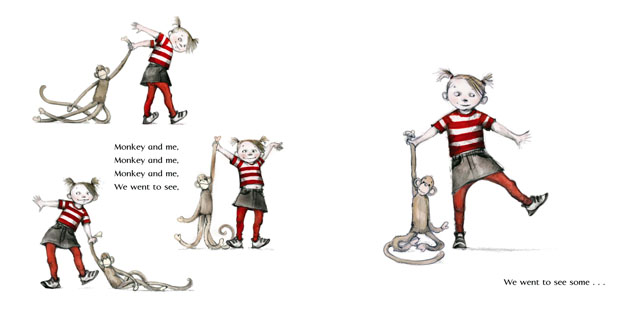
A girl and her stuffed monkey tell us about their exciting day out at the zoo by jumping up and down and posing as all the different animals they have seen for us to guess what they are. They waddle about with their feet sticking out like penguins, the girl jumps with the monkey tucked in her t-shirt like a kangaroo, they hang upside down like bats, the girl bends over and uses an arm for an elephant's trunk and they both jump and hang from things like -real- monkeys. Each picture charade has a catchy repetitive chant to go with it:

"Monkey and me
 Monkey and me
 Monkey and me
 We went to see
 We went to see some...

(Penguins/ Kangaroos/ Bats/ Elephants/ Monkeys)"

At the end, exhausted by all the excitement, the girl and her toy monkey go home for tea and fall asleep (the toy monkey too).

The Illustrations
Monkey and Me's illustrations are brimming with movement and energy and, combined with the catchy chanting, are contagious for readers and listeners.

In her pencil and watercolour illustrations on a white background, Emily Gravett uses colour sparingly and effectively (red for the girl's t-shirt and tights, grey-brown for the toy monkey and shades of brown and grey for the different animals).

The illustrations are full of plenty of little details for toddlers to notice over time. We love the stuffed monkey's facial expression, inexpressive all the way through until they start imitating the monkeys, when it turns into a broad smile, and stays that way until the end. (We love the idea of a stuffed monkey going to see real monkeys!).

In the last scene, the girl and stuffed monkey have fallen asleep at the dinner table. On the table lies a plate with a couple of chips left over, a small yoghurt pot, an uneaten open banana, a drawing of their day with the couple of pencils -red and grey, like most of the book-, they have used to draw it. A nicely subtle layer of sophistication is added by having a real monkey creep into the scene, perhaps to take the banana, while the girl and the stuffed monkey sleep.

I personally love the girl's sagging tights.

Here are some of the illustrations from Monkey and Me: 


Imitating penguins:


Imitating bats:


And a close-up of the end scene (unfortunately, I cannot find the full scene online):


Reading it out loud
Monkey and Me is a great read aloud story and game.

Young babies will appreciate the repetitive chanting. Young toddlers will enjoy recognising the animals and eventually crying out their names with each page turn. We also use it as a sort of counting book. My son thinks it's very funny when we count all 26 bats very quickly. He also seems to be about to start imitating the girl and her stuffed monkey and their animal poses.

It has a nice excitement curve, quietening down at the end, when it manages to convey that satisfied tiredness of a kid after spending a whole day out and about.


My son loves the big red fish in the beak of one of the penguins and has recently taken to imploring mercy:  'Don't eat!"

He also loves the picture of the girl and her monkey hanging upside down like bats. He likes pointing to her belly -"BELLY BUTTON!"- and saying "UPSIDE DOWN!" and turning the book upside down to see their faces properly.

Monkey and Me offers lots of opportunity for joining in, dancing to the song and playing.

Plenty, plenty of fun!


Other comments
It's nice of Emily Gravett to give us a girl with more thrill than frill in this return of the pink princess era.

Emily Gravett has a superb website, wonderfully designed, fun and informative. It includes videos of the way she works. Take a look at http://www.emilygravett.com/.

(c) of all the illustrations in this post, Emily Gravett, 2007.

Saturday, 26 March 2011

Tiddler, The Story-Telling Fish: OH, YES, HE DID!

Tiddler. The Story-Telling Fish. Julia Donaldson and Axel Scheffler, 2007.
Alison Green Books, Scholastic Children's Books, 2010.


Click above to listen to the way we read Tiddler, The Story-Telling Fish. 

I have gradually come round to thinking this may be one of the best stories for reading aloud to under two-year-olds (and over) we have. It has a flowing, effortless rhythm, becoming almost a gentle rap when you read it out loud, plus plenty of repetition and opportunities to join in.

The story
Tiddler is a little fish that "blows small bubbles but tells tall tales". Every day he arrives late for fish school and every day his excuse is a taller tale, ranging from having been riding on a seahorse to having been trapped in a treasure chest and set free by a mermaid. At school nobody really believes him except impressionable Little Johnny Dory, who is so excited by his stories that he tells them to his granny, who in turn tells them to a plaice, and thus the stories are spread across the ocean. One day while dreaming up his next fantasy, he actually gets to live a real adventure of his own. Poor little Tiddler gets fished!

Fortunately, the fishermen throw him back because he is too small, but Tiddler is lost, frightened and does not know how to get back. But then he hears a rather familiar story about himself being chanted by a shoal of anchovies, and follows the story across the ocean from shrimp to whale to herring to eel to lobster to seal, back home and to his classroom, where, as always, nobody believes him except Little Johnny Dory, who does something rather special for Tiddler at the end.  

The Illustrations
Axel Scheffler's vivid and colourful pen, ink and pencil illustrations, full of detail and expressiveness, really come to life in Tiddler.

By the time we got Tiddler, my son was already acquainted with Scheffler's illustrations from The Gruffalo and Room on the Broom, so he took to these immediately. We really like all the different types of fish and all the sea life -Tiddler was responsible for my son's octopus and shark phase- and the fish school scenes are very good fun. And then of course, there is the gruffalo fish that pops up midway through the book. I think it was one of the first times I saw my son laugh for a reason other than tickling or hearing a funny noise.

Here are some illustrations from Tiddler:

Opening  double page spread, with Tiddler at the centre of the first page
and some of his excuses for arriving late portrayed on the second page


Mermaid rescuing Tiddler with a shark lurking about


Granny Dory telling Tiddler's story to her friend the plaice


Tiddler being captured by the net!


Reading it out loud

When we first got Tiddler, and the first couple of times I read it, I have to say I was not too sure about it. There was something about the story, in particular the ending, that seemed to fall flat. But the more we read it out loud, the more we got into the flowing rhythm and the more our son enjoyed it. It has a wonderful musicality and a few nice repetitive structures for small listeners to join in. It quickly became one of our favourites.

Tiddler was our son's first goodnight story. We always read other bedtime stories before, on the sofa, but Tiddler was the first story we took into his own bedroom to read to him just before he dropped off to sleep.

One of the interesting things about reading it out loud is the different effects it can have depending on the speed at which you read it. Because it was our son's goodnight story every single night for a good few months, we realised that when he was very tired we were reading it to him very quickly, almost rapping it. Perfect for a sleepy boy. But then other times, for more alert moods, we read it more slowly and allow time for stopping, looking, pointing and joining in. The recording is probably somewhere in between:


Our son joins in every time Miss Skate calls the register at fish school:
"Tiddler? Tiddler? TIDDLER'S LATE!":


And in every "Oh no, s/he didn't", "OH, YES, S/HE DID"!


Other comments
Since the Tiddler months, we have had briefer bedtime flirts with Eric Carle's The Very Quiet Cricket, Donaldson and Scheffler's The Snail and the Whale, and Sam McBratney and Anita Jeram's Guess How Much I Love You, a very long love story with Maurice Sendak's The Nutshell Library every single night for months and, a recent move, on to The Boy in the Garden by Allen Say, but I'm sure he'll return to Tiddler at some point.


Tiddler is "The boy who cried wolf" (in fact it was even released in some places as The fish who cried wolf) with the moral refreshingly left out.

I'm still not sure about the ending, though.

(c) of all illustrations in this post, Axel Scheffler, 2007.