Lee este blog en español:
Lo leemos así

Read my other blog:

Interested in Philosophy for Children?
Showing posts with label Maurice Sendak. Show all posts

Friday, 21 December 2012

Special Christmas reading of In the Night Kitchen from us all at We Read it Like This!

Merry Christmas and a very Happy New Year
 from We Read it Like This! 

To celebrate, we have prepared an extra special reading of In the Night Kitchen by Maurice Sendak, with the following music: 

Blue Drag by Django Reinhardt (performed by Allen Toussaint) 
 "Kitchen banging and clanging", courtesy of Over the Hillside by Blue Nile
and special guest performance by Ángel Carmona on the ukelele.  


Enjoy! Read more about In the Night Kitchen here. 

And as a final send off to Sendak, here is his super 'baubled, bangled Christmas tree with soup bowls draped all over me' from Chicken Soup with Rice (The Nutshell Library)

Merry once, merry twice, merry chicken soup with rice! 

Thursday, 14 June 2012

Outside Over There: "But never watched"

Outside Over There de Maurice Sendak
The Bodley Head, 1981
Our edition: Red Fox (Random House), 2002


Since my wide-eyed, somewhat uncertain reaction to Outside Over There the first time I read it, ten months have gone by and it has become one of our unquestionable favourites. This I owe mainly to Sendak, who is a master of books that grow with each reading, but also to a great extent to my son, who made me see clearer than ever before, that adult fears about what might make children afraid are usually based on... adult fears. 

Outside Over There is a perfect combination of two melodies, one image-based and the other language-based, interwoven to suggest an abundance of meanings brimming with an almost lavish ambiguity. It's magic and the result is hypnotic for children and adults alike. 

The story
Ida, an 8-10 year old girl, has to look after her baby sister while her father is away at sea and her mother sits there waiting, her eyes lost somewhere in the horizon, just as absent as he is. "When Papa was away at sea and Mama in the arbor, Ida played her wonder horn to rock the baby still -but never watched". When some goblins take advantage of Ida's inattention and force their way in through the window to kidnap baby, Ida must face up to her responsibility, and she does so bravely, venturing out to rescue her sister. But she makes "a serious mistake", and "climbs backwards out her window into outside over there". With the help of a song her father sends her from the distant ocean, she manages to "tumble right side round" and enter the caves of the goblins, "just babies like her sister", disarm them with the melody of her wonder horn, find her sister from out of all the babies there and take her back to the safety of their home, where their mother is waiting for them with a letter from their father asking Ida to look after her mother and her sister until he returns. "Which is just what Ida did".

Sendak takes many traditional fairytale elements and plays with them to portray the ambivalent feelings of an older sister towards her baby sister, her internal search to identify and control her emotions and the maturing of her love towards her sister and family.

It broaches responsibility (together with fear of failure), braveness and survival in an often incomprehensible world, portrayed from the child's very incomprehension of their emotions and from their own process of learning, adapting  and fitting in with other people and other elements in the world. 

The text of Outside Over There, which Maurice Sendak said he revised more than one hundred times, is poetically hypnotic, with each word and each sound carefully and purposefully chosen to incorporate all the ambiguity and generate all the clash of feelings that it intends to, combining almost musically with the images. 

The illustrations

Outside Over There came after Sendak illustrated the Grimm tales, for which he went on a trip to Germany, where he fell in love with the German romantics, "passionately", in his own words. And with that sense of humour of his he explains that "Outside Over There is like a bad Runge painting". 

These are some of the images we find most fascinating from Outside Over There. 

Possibly the most impressive image in the book, with the goblins taking the baby and leaving in its stead another made of ice.
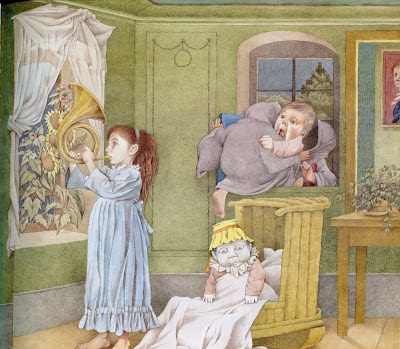
"So the goblins came"


Here we see Ida, preparing to rescue her sister. Look at the sunflowers, and how they have grown gradually from illustration to illustration, slowly and menacingly invading the room. Like in Where the Wild Things Are, the vegetation grows with the intensity of the fantasy, except that in Max's room it grow outwards, whereas here it comes from outside to penetrate the interior of the "safe" home.  
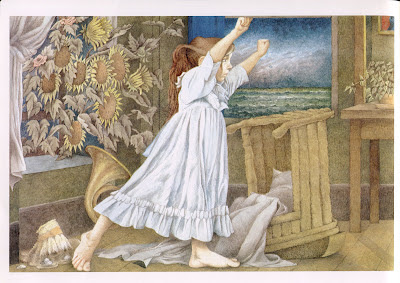
They stole my sister away! 


Ida making the "serious mistake" of climbing "backwards out her window into outside over there".
Backwards


Ida with her wonder horn, trying to drive the goblins away: 
"Ida played a frenzied jig"


On their way home. Could that tree be standing in wait for them? No, it just looks like it might be.
"Ida glad hugged baby tight"


The illustrations in Outside Over There are so full of detail, symbols, reference and allusions that I do not know if they ever end. Every time I open it, I find something new.

We can analyse what we see out of the window of the room where Ida and the baby are. At the start we see some trees against a peaceful afternoon sky. When they take the baby, the trees are still there, but the sky has gone dark. When they have already taken the baby but Ida has not yet realised, the trees have disappeared and we see a view of a boat on a sea just starting to stir. By the time Ida realises what has happened, the sea is in full roar and the ship has sunk. Ida ventures out right in the middle of the storm to rescue her sister and by the time she saves her, the sky is calm again, almost morning.

We can count sheep and shepherds that appear occasionally as pastoral motifs. We can stop and look at a little house and spot Mozart playing the piano. We can spend time having a good look at those huge feet Sendak likes to give many of his characters. We can delight in the details of the landscape, the trees, the water, the ivy, the folds of the cloaks and capes and the looks on faces. But we can also stand back a little, see the full picture and let the images evoke all the complexity of feelings they generate in us and enjoy it.

My son was visually attracted to Outside Over There from the word go and this attraction has only increased over time.

Reading out loud
The first time you read Outside Over There it might strike you as somewhat odd. It is not easy to find the rhythm and cadence immediately. It sometimes seems to stop when it should continue and continue when it should stop, it plays constantly with your ear's expectations (if you expect a rhyme it never comes when you think it should, but when you least expect it, a bit after, a bit before or never). However, the more you read it and the more you make it yours, it is precisely those parts that were frustrating or odd the first times that strike you as so exceptionally beautiful and poetically forceful. 

Sendak stretches sentences mercilessly. As someone reading out loud, he loses you for just a second and then takes you by the hand and returns you to your place gently, without you realising. The experience of reading it out loud is almost as if you were sent along an unknown path and on the way were provided with the tools required so as not to get lost. 

I perceive this subjective experience as a reader mirrored in my most faithful listener. From the first sentence, he is entirely captivated by the story. It's funny but my son rarely interrupts me when I'm reading this book, as he does with many others. If we look at the details in the illustrations it is normally after we read it in full, as if he needed to go over the content for the experience to be complete.  

There is a whispered sentence, a cry of fear, a rhymed song, several exclamations and finally the father's letter that serve to break the rhythm and keep the attention of listeners at all times.

Outside Over There is a very special book for reading out loud.

More on Outside Over There 
Outside Over There is the third book of what the late Maurice Sendak considered to be a trilogy on "how children master various feelings - danger, boredom, fear, frustration, jealousy - and manage to come to grips with the realities of their lives.'' The other two books that make up the trilogy are Where the Wild Things Are and In the Night Kitchen. 

Although the three books are visually very different, they are all fantasies where a child has an adventure in which they must face and overcome a series of never explicitly revealed obstacles before returning to the comfort of their home (or bed, or hot soup as the case may be). 

Where the Wild Things was initially received with a degree of apprehension due to the perception that those monsters might be too frightening for children or because Max's "naughty" behaviour was not condemned. In the Night Kitchen suffered mutilations and badly drawn-on modesty nappies by nasty-minded, twisted and dim librarians and school staff. Of all three of them, however, Outside Over There is possibly the book that has caused the greatest feelings of unease, concern and fear about its appropriateness for children. 

I must confess that the first time I read it, apart from the strangeness of the text, I was rather impressed by the whole book and something happened to me that I had never experienced before with a children's book. I asked myself whether I really wanted to read it to my son, who was then about two and a half years old. On the one hand, I may have thought he was too young to be interested, but I also think I asked myself whether it was "appropriate". I have never felt that kind of instinctive apprehension about a book before. And for one moment, I put it to one side. But that very afternoon, my son saw it, picked it up and brought it to me for me to read it to him. I decided to try it out. And I was taken aback by how much he liked it at once. He asked me to read it again and again and, almost a year later, he continues to do so. It is a book he is very much attracted to, almost hypnotically so. 

Why does this book awaken such unease among parents and adults in general? Even among parents and adults predisposed to feeling and thinking otherwise? Undoubtedly the illustrations and the text evoke so many things and such ambiguous things that it touches very uncomfortable areas of our adult unconscious mind. 

But I think it is likely that getting stuck on those things it touches for adults is to focus on the superficial. As Sendak himself once said, "It's only adults who read the top layers most of the time. I think children read the internal meanings of everything" (The Art of Maurice Sendak, by Selma Lanes). And here the internal meanings are much more about the ambivalent feelings of the big sister towards her baby sister. The book is about love, responsibility (a source of fear and pride in equal measure) and heroism. It is about coming to grips with the complexity of love towards your siblings and family in a world full of confusion. It is about the terrible feeling of having a responsibility and failing or making a mistake. But it is also about learning to cope with your mistakes and set them right. I think this reaches children in an intuitive way. 

Sendak does not tell us what the child feels; he makes us react to them. He doesn't become the voice of the child; he invites us to look and feel; both through identification and observation. Depending on the age, when reading Outside Over There children may feel admiration towards Ida. How brave, what a hero! Perhaps they'd also wish for a yellow cloak like that or fantasise about having a baby sister. They may also have a feeling of enjoyable fear, the kind where you cover up your eyes but peek out through your fingers because you can't help looking. My son gets very angry with the goblins when they take the baby and says he's going to hit them with a big stick if he sees them (recently his big imaginary stick is going to solve all the world's ills). He also gets angry with the fraudulent ice baby. But he loves to see that Ida has found her sister at last and how she takes her home.  

Adults however, might spend the book worrying about any possible sexual connotations of Ida portrayed a bit like Bernini's Ecstasy of Saint Teresa, about the mention of the baby being a "goblin's bride", about the ambiguity of the expression “rock the baby still”. Why not just "rock the baby to sleep"?

What is wonderful about Sendak is that he never scolds or lectures the child (except as a joke, in Pierre, for example). But he doesn't scold or lecture the adult who reads it out loud either (an increasingly popular line in picture books). He always focuses on the child's internal process as something they must (and can) resolve by themselves. He also always bears in mind that childhood is a very confusing time, even if you have a united, loving family. That no excuses or justifications are needed to explain why a child may feel miserable, confused or resentful. That what is interesting is that it is very likely that all children feel these things at some point, because it is part of their emotional and personal development. And what is interesting is for the child to realise that it is in their power to learn to understand, express and control or let out their emotions and feelings. Perhaps that is why his books are ultimately so comforting and empowering for children.   

I shall finish with a quote from Sendak about Outside Over There: 

"It was the story of me and my sister, basically. She’s Ida and her vexation, if not rage, in having to take care of me. To insinuate that as part of a relationship in a book for children is hard for critics because there’s a misconception of what is a children’s book and what it should contain and should not contain and what the subject matter should be and should not be. And primarily it is to be healthy and funny and clever and up-beat and not show the little tattered edges of what life was like. But I remembered what life was like and I didn’t know what else to write about." 

Tidbit
Jim Henson's film Labyrinth was inspired by Outside Over There (Where the Wild Things Are and Outside Over There actually appear on a shelf at one point in the film, and Jim Henson acknowledges his debt to the works of Maurice Sendak in the credits. 

(c) of the illustrations, Maurice Sendak, 1981.
(c) of the text, Ellen Duthie, 2012. By all means copy it or reproduce it but please be nice and cite your source (author and blog).


Other reviews, readings and pieces on Maurice Sendak at We Read it Like This:


Wednesday, 9 May 2012

Did you ever hear of Sendak, how he wrote the best books for children and shouted 'Quiet up there!'?

Maurice Sendak, Kenny's Window, 1956.


The news of Maurice Sendak's death yesterday, at the age of 83 caught me off-guard.

Last week I received a copy of Dear Genius, a selection from the intensely personal, perceptive and generous professional letters of one of the most influential figures in children's literature in the 20th century, the children's book editor Ursula Nordstrom. She was directly or indirectly responsible for discovering, spotting or encouraging authors and helping them produce such classics as Where the Wild Things Are, In the Night Kitchen (Maurice Sendak), Goodnight Moon, The Runaway Rabbit (Margaret Wise Brown), Harold and the Purple Crayon (Crocket Johnson), Stuart Little (E. B. White) and The Giving Tree (Shel Silverstein), to name only a few. 

I have really enjoyed reading this and witnessing her extraordinary relationship with the authors. I found myself paying special attention to her letters to Sendak. 

In her letter to Sendak of Feburary 21, 1955, we get a glimpse of the thoroughness of her procedures and her belief in her authors: 
'your new ideas for the ending of Kenny's Window seem wonderful to me [...]. Keep working on it and when you have all the chapters together, you and I can go over it word for word. [...] But the main thing is: Thanks for everything I'm sure you're doing to the book. 
In the same letter, we feel her (genuine) enthusiasm:
As for the colors for the Krauss book -words are no good whatsoever. There are a few peaks in an editor's life and seeing those pictures of yours has been a peak of mine.'
I enjoyed her sense of humour and her expression of friendship.  
 June 10, 1955
Dear Maurice, I mean Marlon: [...]Hope you have a good birthday. [...] As I have said to you other years, I am very glad you got born. 
I enjoyed their discussion on genius and what kind of genius Sendak might be: 

August 21, 1961
[...] 'Yes, Tolstoy is wonderful, but you can express as much emotion and "cohesion and purpose" in some of your drawings as there is in War and Peace. I mean that. You write and draw from the inside out, which is why I said poet.  
[...] You wrote "my world is furniture-less. It is all feeling". Well, feeling (emotion) combined with an artist's discipline is the rarest thing in the world. You love and admire the work of some other contemporary artists and writers today but really, think how few of them have any vigorous emotional vitality? What you have is RARE.'  
 And of course, her expression of excitement and awe at the results of Sendak's work: 
'September 23, 1963
[...] When you were much younger; and had done only a couple of books, I remember I used to write you letters when the books were finished and thank you for "another beautiful" job - or some such dopiness. Now you're rich and famous and need no words of wonder from me. But I must send them, anyhow, when I look through Where the Wild Things Are. I think it is utterly magnificent, and the words are beautiful and meaningful, and it does just what you wanted to do. And you did what you wanted to do.'  
I was still in the middle of reading the letters when, last Sunday I read a post on the blog of another favourite author and illustrator of mine, Sergio Ruzzier (see Amandina), about his experience on The Sendak Fellowship, a residency program set up in 2010 'to give artists the time and space to explore their craft outside the increasing constraints of the publishing world'. I quote Ruzzier:  
'He is a very warm, sweet and witty person, but also very honest. He told me what he liked in my books and what he didn't like. His main concern was that some of my choices were too safe and tame. "You need to be brave" he said to me. I tried to blame the publishers, and he did acknowledge that today's industry, at least in the United States, is not as favorable and nurturing as it was forty or fifty years ago. But that, he told me, should not be an excuse. He is completely right and I already knew that. But talking with him, while walking in the woods with his dog Herman, made me remember why I draw and tell stories.' 
And it struck me how beautifully circular it all was. And how generous for an old man who is tired and needs to prove no more to anyone, to decide to spend the last years of his life nurturing younger illustrators and injecting life, braveness and a sense of urgency to be honest in their work. And I thought to myself that I couldn't think of many more beautiful ways of ending your life. 

And then yesterday, two days after reading Ruzzier's post and one day after finishing Nordstrom's letters, he died. Sendak has been unusually present in my mind over the last few days and perhaps that is why the news has shaken me more than I would have expected. 

I was going to try and sum up what Sendak did and why he was so good at it, but I'll let him do so himself: 
'I think what I’ve offered was different, but not because I drew better than anybody or wrote better than anybody, but because I was more honest than anybody. In the discussion of children and the lives of children and the fantasies of children and the language of children I said anything I wanted. Because I don’t believe in children, I don’t believe in childhood. I don’t believe there is this demarcation. Like, ‘You mustn’t tell them that,  You mustn’t tell them that.’  You can tell them anything you want. Just tell them if it’s true. If it’s true, you tell them.' 
From Tell Them Anything You Want: A Portrait of Maurice Sendak, a documentary by Spike Jonze and Lance Bangs, 2009. Here's a short extract of it:    


I would like to finish this post with three of Sendak's incredibly meaningful and complex opening lines:

Where the Wild Things
The night Max wore his wolf suit and did mischief of one kind and another, his mother called him 'Wild thing' and Max said 'I’ll eat you up' and he was sent to bed without eating anything.
In the Night Kitchen 
Did you ever hear of Mickey, how he heard a racket in the night and shouted ‘Quiet down there!’ and fell  through the dark, out of his clothes, past the moon and his Mama and Papa sleeping tight, into the light of the night kitchen?
Outside Over There
When Papa was away at sea, and Mama in the arbor, Ida played her wonder horn to rock the baby still – but never watched. 
Hard to imagine more "cohesion and purpose" than in these three openings, Mr. Sendak. 

(c) of the illustration, Maurice Sendak, 1956. 
(c) of the text, Ellen Duthie. By all means copy it or reproduce it, but please cite your source (author and blog). 


Reviews and readings of books by Maurice Sendak on We Read it Like This: 


Monday, 9 April 2012

In the Night Kitchen: Stir it! Scrape it! Make it! Bake it!

In the Night Kitchen, by Maurice Sendak, 1970. 
Our edition: Red Fox (Random House), 2001

Click above to listen to our special reading, with music, of In the Night Kitchen. You can read more about this recording here. 

It's hard not to be enthusiastic about Maurice Sendak's elastically rhythmic, delightfully rolling and visually lingering In the Night Kitchen. In Spanish the word redondo -round- can be used to mean perfect. And The Night Kitchen is as round as you get.

In our case at least, this enthusiastic reaction was immediate from adults and child alike. We got this for our son before he was two and it has been a favourite with him (and us) ever since. It has never once gone out of favour (other books of his have periods of glory followed by periods of ostracism before usually returning to glory, depending on shifting moods and interests and a natural attraction to the pile of newly arrived books).

The Story
In the Night Kitchen is an account of a little boy's dream. Mickey falls from his bed through the dark, out of his clothes and into a huge bowl of batter in a noisy night kitchen where three fat Oliver Hardy faced bakers mistake him for milk, mix him in batter and pop him in the oven to bake him into a 'Mickey cake'. But half way through the process, Mickey pokes out, now wearing a dough pilot suit and points out their mistake ('I'm not the milk and the milk's not me! I'm Mickey!'), before jumping onto some bread dough, molding it into a plane and taking off, leaving the bakers below shouting desperately for milk for the morning cake. He flies up and up and over a stunning New York cityscape with food packages and containers for buildings, and reaches the top of a huge bottle of milk, dives down into it, comes up again with a jug full and pours it down into the massive bowl held by the expectant chanting bakers below. Then Mickey gives a triumphant cock-a-doodle-doo and slides back down and straight into bed, "cakefree and dried".

'And that's why, thanks to Mickey, we all have cake in the morning.'

We love the perfectly illogical logic of dream captured here, with the floating and falling and then rising up only to drift down again and back into deep sleep at the end. So satisfyingly circular.    

The Illustrations
The gorgeous deep blue of the artificially lit starry night sky of In the Night Kitchen plays a prominent visual role in the book, setting a definite mood of city night-time excitement, the kind we might have imagined as a child and might still imagine as an adult goes on without us while we sleep.

The only wordless double spread in the book, with Mickey flying 'over the top
of the Milky Way in the night kitchen' and the bakers after their milk. 


Sendak's nostalgic pen & ink and watercolour illustrations for In the Night Kitchen come in comic-like panels of varying sizes, with speach bubbles and text boxes, and plenty and plenty of little details to pore over again and again and again.

Here are a few of our favourite scenes from In the Night Kitchen: 
Telling the racket makers to be quiet


The landing


Explaining the confusion


Our son's favourite chant! And that spoon-banjo playing baker!
Triumphant


One happy sleepy boy


Sendak included many many homages and tributes in In the Night Kitchen, some big some small, some evident and others less, some entirely private and others more public.  

The style and design of the pages are a straight-out tribute to Winsor McCay's wonderfully surreal comic strips Little Nemo in Slumberland, which often start off with Nemo in bed, always end with Nemo back in bed and involve plenty of falling, flying and floating, with food he's eaten (doughnuts, mince pies, raisin cake, sardines) sometimes being blamed for his dreams.

The bakers are Oliver Hardy ("I couldn't use Laurel cause I couldn't use a skinny guy", says Sendak in the documentary Tell Them Anything you Want), but they are also the bakers of a childhood advert that inspired the idea for In the Night Kitchen, with its slogan "We bake while you sleep". I didn't find that advert in particular, but here are the chubby chaps themselves in another piece: 
And they are also a bit Hitlerian with their moustaches and their ovens. And perhaps a bit witchlike with their big bowl/cauldron? 

Another fun thing about the illustrations is looking at all the names on the tin, bottle and jar buildings, where Sendak included references to products in his childhood home pantry.

But the main thing about these illustrations is their vibrancy and the powerful imagery they contain. They are the kind of images that stay with you forever. And as I said at the start of this section, I think the night-time light has a lot to do with why this book draws you in so much. You can almost feel the noise in the quiet. And you are part of it while it lasts. Zzzz. 

Reading it aloud
In the Night Kitchen is one of the best books to read aloud I have ever had the pleasure of coming across.

There is something about Sendak's opening lines (Where the Wild Things Are and Outside Over There, are two other examples of extraordinary opening sentences) about the delightfully free and restrained rhyme and rhythm obtained to a great extent by breaking every convention of rhythm in the book, by stretching sentences over pages and losing you for a second only to come back and take you reassuringly by the hand to the satisfying return to the rhythm broken. Ahh. Ok, I like it:

'Did you ever hear of Mickey, how he heard a racket in the night and shouted 'Quiet down there!' and fell through the dark, out of his clothes, past the moon and his Mama and Papa sleeping tight, into the light of the night kitchen?'

Just Wow.

In the Night Kitchen also has a rambunctious chanty theme to it. What's so marvellous about Sendak here is that it's almost as if he gives you the tune with his language and rhythm. We sing it like in the recording. I'm sure other people might sing it slightly differently, but I doubt whether anyone had to think much about how one might sing it. It flows naturally. 'Milk in the batter! Milk in the batter! Stir it! Scrape it! Make it! Bake it!'

If we add to the chanting, Mickey's occasional outbreaks:
'Quiet down there!'
'I'm not the milk and the milk's not me! I'm Mickey!'
'What's all the fuss? I'm Mickey the pilot! I get milk the Mickey way!'

And of course,
'Cock-a-doodle-doo!'

You can imagine there's a fair bit of joining in here.

My son and all other children I have read it to have all found it great fun and started joining in from the very first reading. ('Milk in the batter!' appears enough times for them to catch onto it straight away).

Another favourite part is: 'But right in the middle of the steaming and the making and the smelling and the baking (my son always adds "and the eating" and thinks it's hilarious), Mickey poked through...".

And one other thing that adds to the rhythm of the text very interestingly is the little sound effects and secondary exclamations inserted in the illustrations (Thump, dump, clump, lump, bump, oh!, aah! ooh, Mama! Papa! Yawn, Oh!, Ho, hum, Yum!) which you can either choose to read inserted in the text or not, but they work marvellously well when you do:

'Did you ever hear of Mickey [thump], how he heard a racket in the night [dump, clump, lump] and shouted 'Quiet down there!' [bump] and fell through the dark [oh!], out of his clothes [aah!], past the moon [ooh] and his Mama and Papa sleeping tight [Mama! Papa!], into the light of the night kitchen?'


Other comments about In the Night Kitchen
  
We love how the potential horror of a little boy being baked in an oven is framed matter-of-factly -is it even fun?- and how Mickey himself saves himself from his fate by taking control and molding dough and dream to suit his desires and remove his fears.

I have purposely decided not to go into the ridiculous repeated banning of In the Night Kitchen because I don't really have much to add to Sendak's comment: 'Mickey has a penis. Gevalt! Who would have thought such a thing could happen to a child?'

For a final treat, I had originally included a link to youtube featuring the excellent short film In the Night Kitchen made by Gene Deitch and narrated by Peter Schickele in 1987, but it seems to have been removed from there and from every other source where it was once available. Sniff sniff. I shall keep looking and include a link if I find one. 

(c) of all the illustrations in this post, Maurice Sendak, 1970. 
(c) of the text in this post, Ellen Duthie, 2012. You may copy this or reproduce it, but please be nice and credit the author and the site. 

More reviews and readings of books by Maurice Sendak on We Read it Like This: 


Thursday, 21 April 2011

The Nutshell Library: Care!

The Nutshell Library, by Maurice Sendak, 1962. HarperCollins. (Includes: Pierre, a cautionary tale in five chapters and a prologue; Chicken Soup with Rice, A Book of Months; One was Johnny, A Counting Book and Alligators all Around, An Alphabet).
          

Listen to the way we read them:


The Nutshell Library is a collection of four miniature book gems that fit perfectly into little hands. Each of the four books that comprise it is also available in a larger format, but I think that misses part of the point as to why they are so much fun and why children take to them immediately.

We bought these for our son when he was about 21 months old and he has since had a full on love affair with all of them together and with each of them separately, in turns. His absolute favourite does seem to be Pierre though.

1. Pierre, a cautionary tale in five chapters and a prologue 


"I can eat you, don't you see?"
"I don't care!"
Described on the miniature dust-jacket as 'A story with a moral air about Pierre, who learned to care', Pierre is basically the story of a little brat whose reply to anything he is asked or told is: 'I don't care!'. Even when his parents leave him at home and a lion comes along and looks him 'right in the eye and asks him if he'd like to die', Pierre answers "I don't care!". So the lion eats him. 

Of course, all ends well, and eventually Pierre is shaken out of the lion in one piece by a doctor remarkably strong for his size.

Relieved that he isn't dead and wanting to be taken home, Pierre's answer to the lion's offer to give them a ride ('If you would care to climb on me, I'll take you there') is, to the great relief of his parents: 'Yes, indeed I care!!'. This delightfully playful short story in rhyme ends with a moral:

"The moral of Pierre is: CARE!"

Here are a couple of scenes from Pierre (don't you like the expression on his face?):
"Good morning darling boy,
you are my only joy"
"I don't care!"

"Don't sit backwards on your chair."
"I dont' care!"
"Or pour syrup in your hair."
"I don't care!"

What we like about Pierre
Pierre's effortlessly musical rhythm really is something special. The repetion of "I don't care" throughout the rhymed poem has a powerful effect on how the mind focuses on the rest of the text, and somehow learns it after just a few readings. In fact, Pierre is the first book my son learnt 'by heart' (if you stopped, he would fill in the next word). What was most remarkable was how quickly this happened (within a few days). Reading other reviews and comments, this appears to be a common occurrence with Pierre (and with the other Nutshell Library books too). I suppose you might just call it catchy, except that catchy usually refers to the refrain or a particular part of a song or poem. This is the whole thing!

I also love the refreshingly casual, playful and unthreatening introduction of the subject of death, already mentioned above, with the lion asking Pierre whether he'd like to die, and suggesting it might be a way of not having to put up with his parents.

"I can eat you, don't you see?"
"I don't care!"
"And you will be inside of me."
"I don't care!"
"Then you'll never have to bother-"
"I don't care!"
"With a mother and a father."
I don't care!"
[...] So the lion ate Pierre.


And then, at the end, when the lion gives "a roar and Pierre falls out upon the floor":

"He rubbed his eyes
and scratched his head
and laughed
because he wasn't dead".


I especially like the way Pierre gives brats a loving literary slap.


2. Chicken Soup with Rice, A Book of Months


'Each month is gay
each season nice,
when eating
chicken soup
with rice".


In this catchy, fun little ode to chicken soup with rice and its endless possibilities, a boy with an uncanny resemblance to Pierre takes us through a year of chicken-soup-with-rice madness, with a poem and illustration for each month of the year.

The scenes for each month include wonders such as sipping hot chicken soup with rice while slipping on the sliding ice, celebrating the boy's snowman's anniversary with "cake for him and soup for me", becoming "a robin lightly dressed" concocting soup inside his nest, pepping up some droopy roses with a drop of chicken soup (we love this one!), becoming a cooking pot cooking soup, riding a crocodile down the soupy Nile, becoming a whale and spouting hot soup and becoming a baubled bangled Christmas tree with soup bowls draped all over him.

Here are some of these great little scenes:


One of our absolute favourites!


That refrain at the end is just so catchy!

What we like about Chicken Soup with Rice
We like the frolicking imagination in Chicken Soup with Rice: thinking it best to become a "robin lightly dressed concocting soup", becoming a cooking pot, and becoming a Christmas tree are fantastic images!

What our son liked best from the beginning was the song-like nature of it, sometimes clapping in rhythm to the end refrain. Merry once (clap), merry twice (clap), merry chicken soup with rice (clap clap clap).

This is his second favourite, after Pierre.

3. Alligators all Around, An Alphabet


Described as "An Alligator jamboree with all letters - A through Z", Alligators all Around is one of the best alphabet books ever. For parents, it's worth it for the "Never Napping" illustration alone (unfortunately I cannot find it online and do not have a scanner at hand, but will try to do something about it soon!). For kids (including very young toddlers) it's delightfully catchy, easy and pleasurable to learn by heart.

Alligators all around describes alligators doing a huge range of things, such as bursting balloons, catching colds, entertaining elephants, imitating Indians, looking like lions, throwing tantrums or wearing wigs.

Here are a few gems from this book:


What we like about Alligators all Around
My son loves the "entertaining elephants" ("elephants!"), the Imitating Indians ("Ow ow ow ow ow!") and the Looking Like Lions ("Roaaar!").

We just love the whole thing!

4. One was Johnny, A Counting Book
Cover illustration for One was Johnny

"One was Johnny - but that's not all,
count the others who came to call."

One was Johnny is a rather special counting book, in that it counts not only forwards but also backwards.


The first page features Johnny, another Pierre look-alike, sitting quietly and happily at home reading a book. On page two, a rat interrupts the peaceful scene:


1 was Johnny who lived by himself,
2 was a rat who jumped on his shelf.

A cat (3) follows the rat, and then a dog (4), a turtle (5), a monkey (6), a blackbird (7), a tiger (8) and a robber (9). Number 10 is a conundrum, what should Johnny do?

"Here's what I'll do - I'll start to count backwards and when I am through -if this house isn't empty, I'll eat all of you!!!".

And they all leave, one by one, until Johnny is finally alone again (at last!), and can go back to reading his book.

Here are some of our favourite illustrations from One was Johnny:

Johhny's first interruption

Half-way through the invasion
    

Full house


What we like about One was Johnny
We like a character who enjoys being on his own, reading quietly in a corner, and the fact that not even the most extravagant of visitors is able to distract him from his wish to continue reading.

My son says bye-bye to each of the characters who leave during the countdown, waving and saying "bye-bye" to them all, except to the blackbird who flies off to Havana, whom he says "¡adiós!" to, in a funny Cuban accent. His father's doing, I'm sure.


Reading them out loud


All four of these books are a real pleasure to read out loud and -judging by the extended period during which The Nutshell Library was a non-negotiable part of bedtime for our son- something rather special to listen to too. These two factors do not always come together -some books might be good but do not withstand more than sixty consecutive nights of reading, at least from the adult reader's point of view-, and when they do happen to coincide, it feels almost exhilarating. 

The fact that they are all so catchy and kids learn them by heart after just a few readings, make them particularly enjoyable for them, allowing them to take an active part in the reading from a very young age and to continue enjoying them until they are about 10. They are fun on so many different levels!

Other comments

It is quite striking just how divorced US and European children's worlds are (used to be?). Neither my husband (despite a wonderful adaptation by Gloria Fuertes having been published in Spain in 1977) nor I had heard of this great little collection before. Ask anyone of our generation and background brought up in the US, though, and they are likely to be overcome by a wave of nostalgia and perhaps break out and start singing the rhymes to the tune of Carole King's 1975 hits from the musical Really Rosie -written by Sendak himself and partly based on these four little books-, or at the very least have a fond recollection of the half-hour animated TV special directed by Sendak, also with Carole King's music.  

We only discovered the animated versions and the Carole King songs a few days ago, when I was doing some research for this post, so our readings of them up until now -listen to the recordings-, have been "untainted" by these other versions. 

Take a look at the animated version of Pierre from the show aired on CBS TV, with music by Carole King (available on iTunes and spotify too -the name of the album is Really Rosie and contains songs to all four of the books in the collection). It's not great quality but it's the best I could find: 


Enjoy, and please do care!It was fascinating showing this to my son the other day and seeing him absolutely transfixed to start with and then breaking out into an uncontrollable giggle: "Pierre!"


(c) Copyright of all the illustrations in this post, Maurice Sendak, 1962. 
More reviews and readings of books by Maurice Sendak on We Read it Like This: