Lee este blog en español:
Lo leemos así

Read my other blog:

Interested in Philosophy for Children?
Showing posts with label animals. Show all posts

Sunday, 22 September 2013

The Amazing Bone: Scrabboonit!

The Amazing Bone
William Steig
Farrar, Straus & Giroux, 1976

The Amazing Bone, by William Steig by We read it like this
Click above to listen to the way we read The Amazing Bone

The text
A book that gets away with featuring a small bone (look inside the piggy's handbag on the cover) as not just a character but a hero deserves attention just for the gall of it. But then we are talking of the same author with a story where the main character turns into a rock (yes, a rock) and remains a rock for a large part of the story (Sylvester and the Magic Pebble), the same author who wrote a story about a rabbit who can turn into a rusty nail at will, and includes the angst-ridden question 'Do nails die?' (Solomon the Rusty Nail), the guy who wrote a story about a man becoming a dog and not being able to communicate to his wife who he really was (Caleb and Kate), the very same man who introduced young readers to the art of abbreviation well before mobile phone texting was invented (CDB!) and the same dude who manages to conjure up a nightmare scene in which the nightmarishness of it all is the sickly niceness of some disgustingly loving children (Shrek!).

So when dreamy Pearl, the charming little pink riding bonnet on the front cover above, decides to dawdle on the way home from school, stopping 'to watch the grownups in town at their grownup work, things she might someday be doing', and then sits on the ground in the forest half way home to take in the beautiful arrival of spring ('the warm air touched her so tenderly, she could almost feel herself changing into a flower') and hears herself say 'I love everything', we are hardly surprised that a bone lying nearby should reply 'So do I'. 'You talk?' asks Pearl. 'In any language' says the bone, 'and I can imitate any sound there is'. The bone and Pearl hit it off straight away and Pearl decides to take the bone home. But on the way, they first have to deal with three highway robbers with pistols and daggers and a fox who is set on Pearl becoming his dinner for the evening. Luckily, the bone has other powers, learnt passively and unknowingly from his previous owner -a witch. One is left wondering how on earth it is possible to combine humour, tenderness, loyalty and friendship with the absurd quite so incredibly naturally. This 1977 Caldecott Honor Book is a big favourite at the moment. In fact, most of William Steig's work is, really.

As always, Steig's language is gorgeously rich and entirely unafraid of 'big words' and poetic prose. On her way home from school, Pearl stops at a barn and stands "gawking as the old gaffers pitch their ringing horseshoes". After announcing that Pearl will be his main course at dinner that night, the fox didn't just grab her; "he seized Pearl in a tight embrace", to which the bone reacts by screaming "Unhand her, you villain", leaving its fiercest insult for a little later: "You worm, you odorifeous wretch!". I see lots of reviews of Steig's work saying readers sometimes feel the need to simplify the language when they read the stories out loud, 'especially for younger children'. Here's a little piece of advice: don't do it! don't do it! don't do it! Steig was not only unafraid of using language interestingly, he was extraordinarily good and using 'difficult' language in context in such a manner that even the youngest of children will understand perfectly well what most of it means. What's more, the 'big words' he often chooses are marvellously sonorous and children are immediately attracted to them - and love learning them. Ultimately, 'odoriferous wretch' sounds one hell of a lot more intriguing and funny as an insult than smelly old miserable fox, whatever your age.


The illustrations
In The Amazing Bone, William Steig's immediately recognisable pen, ink and watercolour illustrations bring us the arrival of spring in its full glory and optimistic abandon, complementing the textual descriptions. "Spring was so bright and beautiful... her light dress felt like petals." "The spring green sparkled in the spring light. Tree toads were trilling. It's the kind of wonderful day," said Pearl, "when wonderful things happen-like my finding you." "Like my finding you!" the bone answered. And it began to whistle a walking tune that made the going very pleasant".
'I love everything,' she heard herself say. 'So do I,' a voice answered.
Pearl straightened up and looked around. No one was there.
'Where are you?' she asked.
Steig is also wonderful at portraying and provoking emotions in his readers. Look below and feel Pearl's fear, pride and despair.
'You can't have my purse,' she said, surprised at her own boldness.

'He wore a spring of lilac in his lapel, he carried a cane and he
 was grinning so the whole world could see his sharp white teeth'. 

'Pushing Pearl along, the fox set out for his hideaway'. 

'I'm only just beginning to live', Pearl whispered [...]. 'I don't want it to end'.
'I know,' said the bone. 

'I regret having to do this to you', said the fox. 'It's nothing personal'. 
Frightening stuff, you'll agree! But then look below and feel the exhilarating joy of the reunion. "Where on earth have you been?", ask Pearl's parents. "We were frazzled with worry". And then the bliss of sleeping safely in the warmth of her own house with the lovely company of her friend the bone.
'The moment the door swung open, she was in her
mother's arms, and right after that in her father's.  
'Sometimes the bone put Pearl to sleep by singing,
or by imitating soft harp music'. 
Reading it out loud
All of Steig's books are a delight to read out loud. Most of his texts are quite a lot longer than today's picture-book standard, but not too long to read in one sitting from a young age.

In The Amazing Bone, the emotional rollercoaster we are taken through is guaranteed to keep ears pricked and eyes peeled for what's coming next. We feel the carefree joy of spring, then the amazement at the magic bone, the fear of being shot and the exhilaration of escaping death, the fear of being eaten, and the final relief of escaping death for the second time that day, followed by the comfort of arriving home to some very worried parents and snuggling down to sleep with the new friend the bone.

Besides the vocabulary, which we already talked about above, with interesting sounding words that serve to perk up little listeners and sometimes give them a giggle too, Steig also intersperses interesting questions and explicit comments which tend not to go unnoticed when reading his books aloud. He gives kids things to think about, all the time. They might think about them then and there or the questions might hang around ringing in their ears for later. A few examples of this in The Amazing Bone are:

"She watched the grownups in town at their grownup work, things she might someday be doing."

"How come you can sneeze?", asks Pearl. "I don't know", replies the bone. "I didn't make the world".

Later, the bone says to the fox: "You must let this beautiful young creature go on living. Have you no shame, sir!" The fox laughed. "Why should I be ashamed? I can't help being the way I am. I didn't make the world."

My son (aged 4.5) likes going back to these and pointing out that the fox says the same phrase as the bone before and wondering why.

At the fox's hideaway, the bone whispers to Pearl: "I know how you feel". "I'm only just beginning to live,", Pearl whispers back. "I don't want it to end". "I know", says the bone.

Another wonderful thing about reading The Amazing Bone out loud of course are the wonderful spell words the bone utters to get rid of the fox: Yibbam! Yibbam sibbible! Jibrakken sibbible digray! Alabam chinook beboppit gebozzle! And our favourite, Scrabboonit!

Reading Steig's books aloud guarantees laughter, concern, delight at magic or supernatural phenomena and children who are never ever talked down to. And boy, do they appreciate it.

Other things we like about The Amazing Bone and Steig in general
First off, we love the idea that a bone can have personality. A clearly defined, engaging personality too!

The first book of Steig's we got was Pete's a Pizza (a wonderful little story pizza boy and a pizza-maker father showing how play can be a very effective way of exiting a bad mood). My son would have been around two years old when we got Pete's a Pizza and he was captivated from the word go. Then we got Shrek! which he also loved, followed closely by Sylvester and the Magic Pebble, which was a very very very big hit with him and us alike. This story of a donkey who finds a magic pebble, by mistake wishes he was a rock and becomes one, was the beginning of our addiction to a number of Steig books about things turning into others and becoming trapped in a way that renders the original identity meaningless and the original identity-holder hopeless (check out Solomon and the Rusty Nail, Caleb and Katie). The Amazing Bone is also 'one of those', even though there is no transformation as such in the book. I like that my son is able to identify it as 'one of those', like Gorky Rises, the story about a frog who concocts a magic liquid that makes him fly and ends with a rock known as Elephant Rock turning into a real elephant. My son often asks, when we read The Amazing Bone, what we think the bone was before. I love that he recognises and has developed a Steig logic in his head.

Many of these books also have other things in common. William Steig makes his characters go through real horror, pain and anguish, but often compensates them with exhilaratingly happy reunion endings. Check out a few here: 

Sylvester and the Magic Pebble 

Sylvester and the Magic Pebble, whole family
cuddling up on the sofa after a bit of a rough experience. .  

Solomon and the Rusty Nail

Brave Irene

Caleb and Kate. Rather nice to find out the dog you took in
around the time your husband went missing...
was in fact your husband all along!

Caleb and Kate

Spinky stops sulking, in Spinky Sulks
Spinky sits on his father's knee. Sometimes he might not be that bad after all.
From Spinky Sulks

A related recurring theme in many of Steig's books is separation (either due to physical impossibility -like Sylvester or Solomon in their rock and nail form- or in coming of age adventures of sorts -Zeke Pippin, Gorky Rises or The Amazing Bone itself-. I love the way that what in most authors would reduce to portraying the fear of not being with your parents, in Steig becomes something so much more layered, where the fear alternates with an almost exhilarating fantasy at the thought they are all out there looking for you. It's a bit like wishing to know how everyone would react if you died, and getting to see for yourself. Reaffirming your loved ones' love for you.

In Spinky Sulks, "Spinky's family was worried. They couldn't stand to see him feeling so wretched".

In Gorky Rises, we are told "Gorky's parents had been out all night searching for him. By now, they were so worried they were ready to kill themselves just to end their misery."

In Caleb and Kate, "Kate longed for her missing husband; she couldn't understand why he'd left her. And how Caleb wished he could speak and explain! He would sprawl by her feet, gnawing a bone, while she worked at her weaving. Often a tear would hang from her lashes, or she would stare through the window and sigh, and Caleb would put his paws in her lap and lick her sad face."

In Solomon the Rusty Nail, Solomon thinks "How his poor parents must be suffering, not knowing what had become of him. How miserable they must be without their child.  

In Zeke Pippin, the pig protagonist slides into dreamland. "There he found his poor mother and father, and his poor brother and sister, all crying their hearts out, showering their clothes and the carpet with hot tears, asking how they could possibly go on without their oh-so-beloved Ezequiel. "If I don't see my angel again soon", his mother wailed, "I'll shoot myself!".

In child readers, I think many of Steig's stories have an effect a bit like the equivalent of the adult fantasy of going to your own funeral and taking comfort in how much everyone misses you. Giving children an idea of how much they might be missed if they go missing is a comforting fantasy. "We were frazzled with worry", say Pearl's parents. "Really? You were?", we can almost hear Pearl thinking.

In two words: Read Steig! 

(c) of all the illustrations in this post, William Steig, 1976.
(c) of the text, Ellen Duthie. Copy it or reproduce it, but please be nice and cite your source (author and blog).

Thursday, 3 May 2012

I Want My Hat Back: Don't ask me any more questions.

I Want my Hat Back by Jon Klassen
Walker Books, 2011


Click above to listen to the way we read I Want my Hat Back

The first book both written and illustrated by Jon Klassen, I Want my Hat Back is a debut that makes you roar for more.

I Want my Hat Back has a cumulative structure, with repetition and mirrored dialogue for read-aloud enjoyment, using tension and timing masterfully for narrative -and comic- effect.  

It is a delightfully naughty and subtle story told in deceptively simple dialogue and illustrations that captivates small and big readers on many different levels. It has lots of thank yous, some rather pathetic lying, one painfully slow brain or two, a double-paged anticipation of a true Western showdown, and a refreshingly pitiless, rather amusing, ending.

The Story (spoiler alert)

A big, cuddly forlorn bear has lost his hat and wants it back. He wanders about asking all the other animals he encounters whether they've seen it. The fox and the frog are concise and to the point: they haven't seen it. The rabbit (we readers notice he's wearing a lovely pointed red hat himself) is more lengthy in his explanation: "No. Why are you asking me. I havent' seen it. I haven´t seen any hats anywhere. I would not steal a hat. Don't ask me any more questions". The bear thanks them each anyway and walks on. The tortoise hasn't seen it but can do with some help climbing a rock. The snake once saw a blue and round hat, but that's not the hat our friend is looking for. The armadillo doesn't even know what a hat is.

Depressed, he lies down and looks up at the sky. "My poor hat. I miss it so much". Then the deer appears and asks him what his hat looks like. As soon as the bear starts describing the hat he remembers where he's seen it, or rather, who he has seen it on. He jumps up and runs back past all the animals, now standing in a neat line next to each other, until he reaches the thief and recovers his hat. "I love my hat".

An ellipsis gives us the full story, though, and when a squirrel comes and asks the happy, hat-wearing bear whether he has seen a rabbit wearing a  hat, the bear answers in a familiar fashion: "No. Why are you asking me. I haven't seen him. I haven't seen any rabbits anywhere....".

The Illustrations
The illustrations in I Want my Hat Back are simple-lined figures on a pale background with at most a few leaves and weeds as props. It is all told in muted colours (shades of grey. brown and beige), except for the red of the hat, which stands out from everything else in the images and is given clever narrative use.

An interesting visual element is the text, colour coded by character (the animals each speak in a different colour).

We love the expression in the bear's eyes. How can such deadpan illustrations convey such despair?
Check out the fox peeking out at us
Why are you asking me? 

We love this snake, his irrelevant chit chat and the colour coded dialogue. 

My poor hat. I miss it so much. 

The moment of recognition! Again, check out those eyes!

Running back to catch the culprit
Western showdown. This is my favourite. You can almost hear the score. 

I love my hat. 

The endpapers, featuring all the book's characters including a hatless bear at the front of the book and a hattted bear at the back, look like gorgeous silky fabric. I wonder who will be the first to produce it for funky children's bedrooms!

Reading it out loud


I Want My Hat Back's cumulative text with repeated dialogue structures makes for great read aloud material, even for very young children, who will also be captivated by the expressive eyes of the bear and the funny looks of the other animals. There's also plenty of occasion for doing silly voices.

But I think this book offers many other powerful reasons for children to engage.


Small children can really identify with a) losing something precious and desperately needing it back, b) finding something nice and wanting to keep it to the extent that you c) try to cover up by lying badly and often verbosely, d) finding the rat who stole your precious something in a) and e) taking it back rather forcefully: "It's MINE". (Or as the bear says, "I like my hat").

I think it is this multi-layered identification that makes children oooh! and aaah! and giggle here, and, at least in our case, we get plenty of the three!

Other comments about I Want my Hat Back

It's the closest I've seen a picture book get to a silent film.

On the one hand, I Want My Hat Back is an introduction to a slightly more sophisticated type of humour than one normally finds in picture books, where double meanings play a key role and the funniness lies in showing and saying something different from what is happening. I've read a few reviews of this book, some off them well argued and interesting  that pose the question as to whether this might be a case of a book that is in fact far more appealing to adults than to children, a book that adults "get" far more than children.

So what is my experience? Do children "get" it? I find, at least in my son, that he has shown a peculiar kind of attraction to the way the story is told, to the mystery and the suspense that forms part of the humour in the book, that I hadn't seen before. I'd venture to say that it's the beginning of an education in humour. Slapstick you do not need to learn, but there is another type of humour that does need to be learned, and the way of learning it is through exposure to it. You might not get it at first, or you might not think there is anything to get (so what?), but the exposure to the playfulness of language and narrative for humourous effect is the beginning of an interesting and joyful learning process. My three-year old son was definitely drawn to it from the first time we read it a few months ago now. Would I say he is drawn to it because of the humour? It would probably be truer to say that many more elements are responsible for him liking it, but definitely, the use of narrative suspense for comic effect works for him, and manages to make him giggle.

Now I'll ask you a question. I think this dim little chap is an armadillo, but other people seem to think it's an opposum or a mole. What do you think? (Note added later: I see Klassen himself describes it as a "mole... thing". But those stripes still throw me...).


I see Jon Klassen's next book is due out on October 12. It features a fish wearing a Magritte-style bowler hat and is called, yes, you got it, This is Not my Hat. 


Read this super interview with Klassen at Seven Impossible Things Before Breakfast. I have to say I jumped at his boyish face! Somehow I expected him to be/look older.

(c) of all the illustrations in this post, Jon Klassen, 2011.
(c) of the text, Ellen Duthie. By all means, copy or reproduce it, but please be nice and cite your source (author and site).

Saturday, 21 April 2012

Caps for Sale: Tsz, tsz, tsz!

Caps for sale. A Tale of a Peddler, Some Monkeys and their Monkey Business
By Esphyr Slobodkina, 1940. 
Our edition: HarperCollings Publishers. Reading Rainbow Book. 


Click above to listed to the way we read Caps for Sale. 


A retelling of a folktale, Caps for Sale brings us a perfectly circular story with repetition, chanting, funny noises, humorous body movements to go with the noises and... monkeys! Lots and lots of naughty monkeys! What more can you ask for?

Well, the idea of a nice nap in the middle of the day, anger and frustration one can identify with, humour and a bit of good old counting thrown in. Caps for Sale has it all!

The Story
A fabulously dapper peddler* with a wonderful moustache walks up and down a one-street village, with a tower of coloured caps for sale piled high on his head shouting 'Caps! Caps for sale! Fifty cents a cap!' Nobody seems to be interested in buying a cap though, so he decides to go for a walk, making his way out of town very very carefully so as not to upset the caps.

He eventually finds a large tree and decides to have a nap. He sits down and slowly slowly leans back onto the trunk. Then he checks all his caps are still there before drifting off to sleep. When he wakes up, he feels for his caps but they are all gone, except his own checked cap. He looks everywhere, but can't find them, until at last he looks up into the tree and what does he see? Sixteen cheeky monkeys wearing sixteen coloured caps smiling down at him.

In his attempt to get back his caps, he tries finger wagging (the monkeys wag back and answer "Tsz, tsz, tsz!"), fist shaking (the monkeys shake back and answer "Tsz, tsz, tsz!", and foot stomping (the monkeys stomp back and again say "Tsz, tsz, tsz!").

The peddler is now so desperate and angry that he takes off his checked cap, throws it down on the ground and starts walking away. But then what do the monkeys do? In perfect mimicry, they too throw the caps on the ground, and the relieved peddler recovers his wares, piles them back onto his head and walks slowly, slowly back to the town shouting ''Caps! Caps for sale! Fifty cents a cap!'

*I'm using US spelling 'peddler' here instead of the British 'pedlar' because the book is in US English and I wanted to avoid confusion. 

The Illustrations

Artist and illustrator Esphyr Slobodkina's original paint and paper collage illustrations for Caps for Sale come in a wonderful palette of orangey red, turquoise blue, mustardy green and ochre, with simple lines and figures for the peddler, the monkeys and the landscape.

They are vivid and memorable and the colours are a real visual treat.

Here are some of our favourite illustrations from Caps for Sale: 


The chap himself, his caps, the street. 


Time for a nap

Shaking a finger: "You monkeys, you,
you give me back my caps!"

Stamping a foot
Desperately angry
Caps recovered
Back to town slowly, slowly. 

For us, Esphyr Slobodkina's Peddler has become another character in our house-come-stage.

As an artist, Slobodkina was one of the founders of the American Abstract Artists (AAA) group. As an illustrator, she was the first person to experiment with collage in picture books and is considered to have had a great influence on subsequent picture book authors of such renown as Leo Lionni  and Eric Carle, to name two of the most obvious names. Read more about Slobodkina here.

Reading it Aloud

Reading Caps for Sale is great fun for readers and listeners alike. As I said in the introduction, it simply has it all. It has repetition, both in the circular structure (walking away from and then back to the village), and in phrases and chanting, funny noises and plenty of mimicable body movements that make it all even more hilarious for young children.

It's not only the finger and fist shaking and the foot stamping, it's also all that checking the caps ("then he put up his hand to feel if they were straight- first his own checked cap, then the gray caps, then the brown caps, then the blue caps, then the red caps on the very top") which is visually great fun, with the reader's hand stretching up and up and up to the top of the pile, or all that looking everywhere for the caps ("he looked to the right of him. No caps. He looked to the left of him. No caps...", and so on).

It's interactive in terms of joining in with the words: "you monkeys, you! You give me back my caps", and then the favourite: the monkeys replying "tsz, tsz tsz". But also interactive in terms of getting up and imitating the peddler, or the monkeys, depending on the mood.

There are also great opportunities to point out colours and to count. It's funny that the peddler is wearing exactly 17 caps including his own and that exactly 16 monkeys appear to pinch all except his.

All the "slowly, slowly" walking while balancing the hats, is also a great opportunity for fun and acting out.

"Caps! Caps for sale! Fiftly cents a cap!"

We love it!


What we like about Caps for Sale 

The fact that the peddler looks so very very smart adds to the humour of him losing it, with finger shaking, fist shaking and foot stamping included. We like that.

It has anger and frustration one can identify with (I'm talking adults and children here) but then brings out the humour and ridiculousness in getting angry. We like that too.


I particularly like the way Caps for Sale makes children shift who they identify with from the peddler to the monkeys and then back to the peddler. They identify with the peddler's loss first and then get seduced by the monkey's mischievous fun, before going back to identifying with the peddler getting his caps back and making it back to town. The fact that they identify with both peddler and monkeys is why they find it particularly hilarious.

Tsz, tsz, tsz!


(c) of all the illustrations in this post, Esphyr Slobodkina, 1940, copyright renewed in 1968.
(c) of the text, Ellen Duthie. By all means, copy or reproduce it, but please be nice and cite your source (author and site). 

Friday, 24 June 2011

Rosie's Walk: Picture book perfection

Rosie's Walk, by Pat Hutchins. The Bodley Head, 1968.
Our edition, Red Fox, Random House Children's Books, 2009.


Rosie's Walk is, simply put, picture book perfection.

A single, plain, thirty-two word sentence sewn together with seven prepositions, tells us of a routine walk of a hen from her coop, across the yard, around the pond, over the haycock, past the mill, through the fence, under the beehives and back to her coop.  But combined with the illustrations? We get a whole other, rather more eventful story of the misfortunes of a very hungry fox who is chasing the oblivious hen on her routine walk and managing to get himself into one silly pickle after another.

We bought it for our son recently and he burst out laughing with every scene where the fox 'gets it' from the very first time we read it. A wonderfully silly giggly book, with loud laughter guaranteed.

The illustrations
Pat Hutchins' pen and ink drawings in Rosie's Walk are delightful compositions made up of intricate geometric patterns in different shades of orange, green and yellow.

Look at the fox's fur in this close-up (!):


The story opens with a double page spread showing the whole farm scene or obstacle course, depending on whose point of view you take:


And we are then taken on a visual tour around the farm with Rosie leading, the desperate fox following and us watching it all.

Here, the fox has almost caught up with Rosie:


But look what's in store for him!:


Voilà one of our son's favourite scenes:


And here's Rosie coming to the end of her walk, with the fox in the distance, running from the bees:


Between, behind and beside the two-dimensional slapstick scenes, there are plenty of little details in the form of flowers, insects and other wildlife, including a wonderful onlooking goat, a rabbit, a snail, two toads who seem keen to be part of the action, a couple of mice, a beaver, a couple of grasshoppers and plenty of bees!


Reading it out loud
This book is more about sharing out loud than strictly reading out loud, as the text is kept to an absolute minimum. It's perfect for pointing things out, laughing and shouting out to the unaware hen. 'Watch out!' Plus, all the little details in every drawing make for plenty of conversation.

We haven't provided a recording for this one because every time we read it, we do it so differently!

What we like about it
I love that the story is absolutely no fun without the illustrations, but hilarious with them.

I like how it very cleverly and simply introduces the sophisticated idea of different perspectives (the hen, the fox, the reader).

(c) of all the illustrations in this post, Pat Hutchins, 1968. 

Saturday, 11 June 2011

The Tiger who Came to Tea: Owp!

The Tiger Who Came to Tea, by Judith Kerr, 1968. 
Our edition: HarperCollins, 2007. 
Click on the cover to listen to the way we read The Tiger Who Came to Tea. 

First published in 1968, Judith Kerr's The Tiger Who Came to Tea continues to be one of the best selling and best loved children's books in the UK. It was an instant hit with my son too when we bought it for him at around the age of eighteen months, and seems to be set to continue to be one of his favourites for some time to come.

The secret behind having remained a hit over forty years after its publication date, despite more than a couple of dated elements -some of which, such as the reference to 'Daddy's beer', rather amusing to refer to out loud- has to be the charming and surreal matter-of-factness and nonchalance of how the girl and the mother in the story let a tiger in to have tea with them in their kitchen.

The sudden appearance of this 'big, furry, stripey tiger' in an entirely routine mother-and-daughter scene is portrayed as exciting and fun, but at the same time, as something absolutely natural and fine. A tiger for tea? No problem, we can handle that. The mother and daughter are both part and onlookers of each of the scenes and this makes readers feel like they are also both watching and taking part. It draws you into a story and into the rather fun possibility that the doorbell could ring any time now and it just could be a tiger. How about that as a thought to entertain on a rainy afternoon?

The story
Sophie and her mother are having their afternoon tea in the kitchen when the doorbell rings. They wonder who it might be, but cannot think of who, so go to the door and see. 

When Sophie opens the door she finds a tiger who politely invites himself in: "Excuse me, but I'm very hungry. Do you think I could have tea with you?". Sophie's mother lets him in and offers him a sandwich. The tiger eats all the sandwiches on the plate in one big mouthful. 'Owp!', and, still looking hungry, proceeds to do the same with all the buns, all the biscuits, all the cake, washing it down with all the milk in the jug and all the tea in the teapot. He then looks round for more, until he eats every last bit of food and every last bit of liquid in the house, including all the water in the drains. 

He then, also very politely, says "Thank you for my nice tea. I think I'd better go now", and leaves.   

When Sophie's Daddy gets back, they tell him all about the tiger and what happened and he suggests they go out for a meal. So they go out in the dark, with 'all the street lamps lit' and eat in a cafe.

The next day Sophie and her mummy go shopping and remember to buy a tin of tiger food just in case.

The illustrations
  
Judith Kerr's ink and crayon illustrations use a warm palette of colours to achieve a marvellously expressive portrayal of a very remarkable experience in comfortingly familiar terms. 

Here are a few of the illustrations from The Tiger Who Came to Tea: 

The tiger sits down to tea

Drinking all the tea in the teapot
Drinking all the water in the tap

I must say I absolutely love the tiger's nice, cheeky face. 

And I love Daddy's matching tie and socks, here:


Reading it out loud

The Tiger Who Came to Tea is great to read out loud for several reasons. It has repetition (mainly with "all": all the tea in the teapot, all the packets in the cupboard, all the street lamps were on..."), dialogue (a chance to do different voices), and a wonderfully restrained and effective use of occasional rhyme (tea, be, key, see).   

There were several things our son loved about The Tiger Who Came to Tea from the very beginning, when he was about 18 months. He particularly loved: 1) the tiger eating everything up in one big mouthful: 'OWP!'-this has been used more than once as a mealtime encouragement and works wonders-, 2) the picture of Daddy holding his key: 'KEY!', 3) the image of Daddy arriving home and taking his hat off: 'Hello!' -we add in the 'Hello'-, 4) pointing out the sausages they are eating in the café and 5) the tiger playing the trumpet at the end: Good-bye--- Good-bye... Good-bye -we ended up buying him a wee toy trumpet as a result-.

From the point of view of the person reading it out loud, it's got a nice rhythm and flow to it and comfortably withstands more than a couple of consecutive readings. 

Bits and bobs

Lots of people seem to get upset about the mother being a bit of a 'drip', the tiger drinking 'all of Daddy's beer' and them having 'nothing for Daddy's supper'. It is true that even for the 60s, it's all a bit 50s. If it really upsets you, I suppose you can always change those bits or leave them out (but then would you change the meal at the end for something healthier than sasauges, chips and ice-cream too?). In the version that was published in Spain last year, they 'edited out' both those references to Daddy. On the other hand, you could also lighten up and enjoy the thrill of letting a stranger into your house. 

One of the things I love about the end of The Tiger Who Came to Tea is the sense of something special going on when they venture out of the house for dinner and it's dark outside. 'All the street lights were lit and all the cars had their lights on'. Almost as exciting as a tiger coming to tea.

If you are interested in reading more about Judith Kerr (also the author of the Mog series and of When Hitler Stole the Pink Rabbit), try these links here: 


(c) of all the illustrations in this post, Judith Kerr, 1968. 


Thursday, 14 April 2011

Monkey and Me: Time for Charades!

Monkey and Me, by Emily Gravett, 2007.
Our edition: Macmillan Children's Books, 2010.
Click on the cover to listen to the way we read Monkey and Me by Emily Gravett. 


Click here to listen to how we sometimes read it like a counting book: 


Monkey and Me is a brilliantly simple and unannounced chanted game of charades. I think this would be great fun from around six months to ages 3-4. We got it for our son when he was about one year old.

The Story
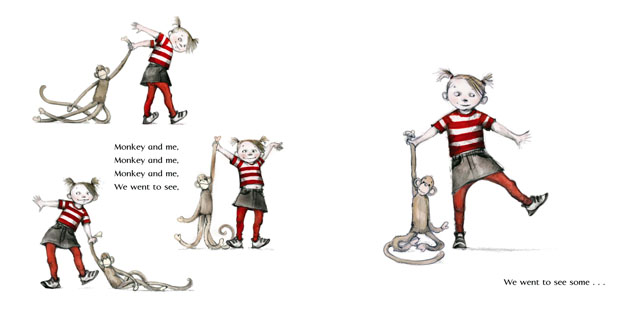
A girl and her stuffed monkey tell us about their exciting day out at the zoo by jumping up and down and posing as all the different animals they have seen for us to guess what they are. They waddle about with their feet sticking out like penguins, the girl jumps with the monkey tucked in her t-shirt like a kangaroo, they hang upside down like bats, the girl bends over and uses an arm for an elephant's trunk and they both jump and hang from things like -real- monkeys. Each picture charade has a catchy repetitive chant to go with it:

"Monkey and me
 Monkey and me
 Monkey and me
 We went to see
 We went to see some...

(Penguins/ Kangaroos/ Bats/ Elephants/ Monkeys)"

At the end, exhausted by all the excitement, the girl and her toy monkey go home for tea and fall asleep (the toy monkey too).

The Illustrations
Monkey and Me's illustrations are brimming with movement and energy and, combined with the catchy chanting, are contagious for readers and listeners.

In her pencil and watercolour illustrations on a white background, Emily Gravett uses colour sparingly and effectively (red for the girl's t-shirt and tights, grey-brown for the toy monkey and shades of brown and grey for the different animals).

The illustrations are full of plenty of little details for toddlers to notice over time. We love the stuffed monkey's facial expression, inexpressive all the way through until they start imitating the monkeys, when it turns into a broad smile, and stays that way until the end. (We love the idea of a stuffed monkey going to see real monkeys!).

In the last scene, the girl and stuffed monkey have fallen asleep at the dinner table. On the table lies a plate with a couple of chips left over, a small yoghurt pot, an uneaten open banana, a drawing of their day with the couple of pencils -red and grey, like most of the book-, they have used to draw it. A nicely subtle layer of sophistication is added by having a real monkey creep into the scene, perhaps to take the banana, while the girl and the stuffed monkey sleep.

I personally love the girl's sagging tights.

Here are some of the illustrations from Monkey and Me: 


Imitating penguins:


Imitating bats:


And a close-up of the end scene (unfortunately, I cannot find the full scene online):


Reading it out loud
Monkey and Me is a great read aloud story and game.

Young babies will appreciate the repetitive chanting. Young toddlers will enjoy recognising the animals and eventually crying out their names with each page turn. We also use it as a sort of counting book. My son thinks it's very funny when we count all 26 bats very quickly. He also seems to be about to start imitating the girl and her stuffed monkey and their animal poses.

It has a nice excitement curve, quietening down at the end, when it manages to convey that satisfied tiredness of a kid after spending a whole day out and about.


My son loves the big red fish in the beak of one of the penguins and has recently taken to imploring mercy:  'Don't eat!"

He also loves the picture of the girl and her monkey hanging upside down like bats. He likes pointing to her belly -"BELLY BUTTON!"- and saying "UPSIDE DOWN!" and turning the book upside down to see their faces properly.

Monkey and Me offers lots of opportunity for joining in, dancing to the song and playing.

Plenty, plenty of fun!


Other comments
It's nice of Emily Gravett to give us a girl with more thrill than frill in this return of the pink princess era.

Emily Gravett has a superb website, wonderfully designed, fun and informative. It includes videos of the way she works. Take a look at http://www.emilygravett.com/.

(c) of all the illustrations in this post, Emily Gravett, 2007.